How My Laundry Room Became a Brewery, and My Backyard a Tire Storage Facility

I remember the night I picked a fight with my husband about the laundry room.  I distinctly remember saying something like, “it’s our laundry room, NOT your brewery!”  I look back on that now, and laugh at myself.  I’m thankful he was so patient with me at the time.  There are things that are worth fighting over, and there are things that just aren’t.  I realize now, that the ratio of washer/dryer square footage to brewing equipment in the laundry room is something that just isn’t worth it.  I learned an important lesson after pondering what happened within me that night to cause my anger.  I seemed to think that I had more rights to our laundry room than he did, but that’s just it – it is our laundry room, not mine.

Let’s back up a bit.  I’ll fill you in on my husband’s hobbies.  He’s had a lot of them throughout the length of our marriage, and most haven’t stuck for more than a few years.  It’d be fair to say we regret spending money on some of them now, but he was learning and exploring, and they were important to him at the time.  (I’ve regretted purchases too.) So when he was gifted some beer making supplies and decided he’d take it up, I assumed it would be one of those hobbies that he’d do once or twice, and then let fall along the wayside.

I was wrong.  He is passionate about brewing.

Years, and dozens of home-brewed IPA’s, honey-browns, and English bitters later, he’s got a sizeable brewery in our home, and is constantly stunning tasters of his beer with how great they are.  His friends are benefiting from his generosity and love of sharing his craft with anyone who appreciates it.

He used to take over our kitchen for a day to complete the brewing process, and leave our entire house smelling like sweet malt.  People would ask me, “don’t you hate that he makes your whole house smell like a brewery?”  I didn’t actually.  Or they’d ask, “how come you let your husband take over your whole kitchen for that?”

Although some hobbies were costly, he made money with others – his “side-hustles” as he likes to call them.  He’s very gifted and can fix almost anything.  He’s also patient in dealing with online shoppers from our local used items listing website; he has a small hobby of taking old, broken things, fixing them up, and selling them at low prices for quick turn-over.

At one point, a few years ago, we had close to 50 used tires in our backyard.  I mean, they were everywhere! I borrowed a bunch to take to school for an obstacle course for the kids once; we even threw a Cross-fit themed birthday party for a friend and used them for challenges and a winner’s podium!  Again with the comments, and from the guys too! “My wife would never let me keep junk like that in our backyard.”  “How do you get her to let you fill your backyard with all those tires?” That’s sad to me, that my guy friends felt that way about their wives.

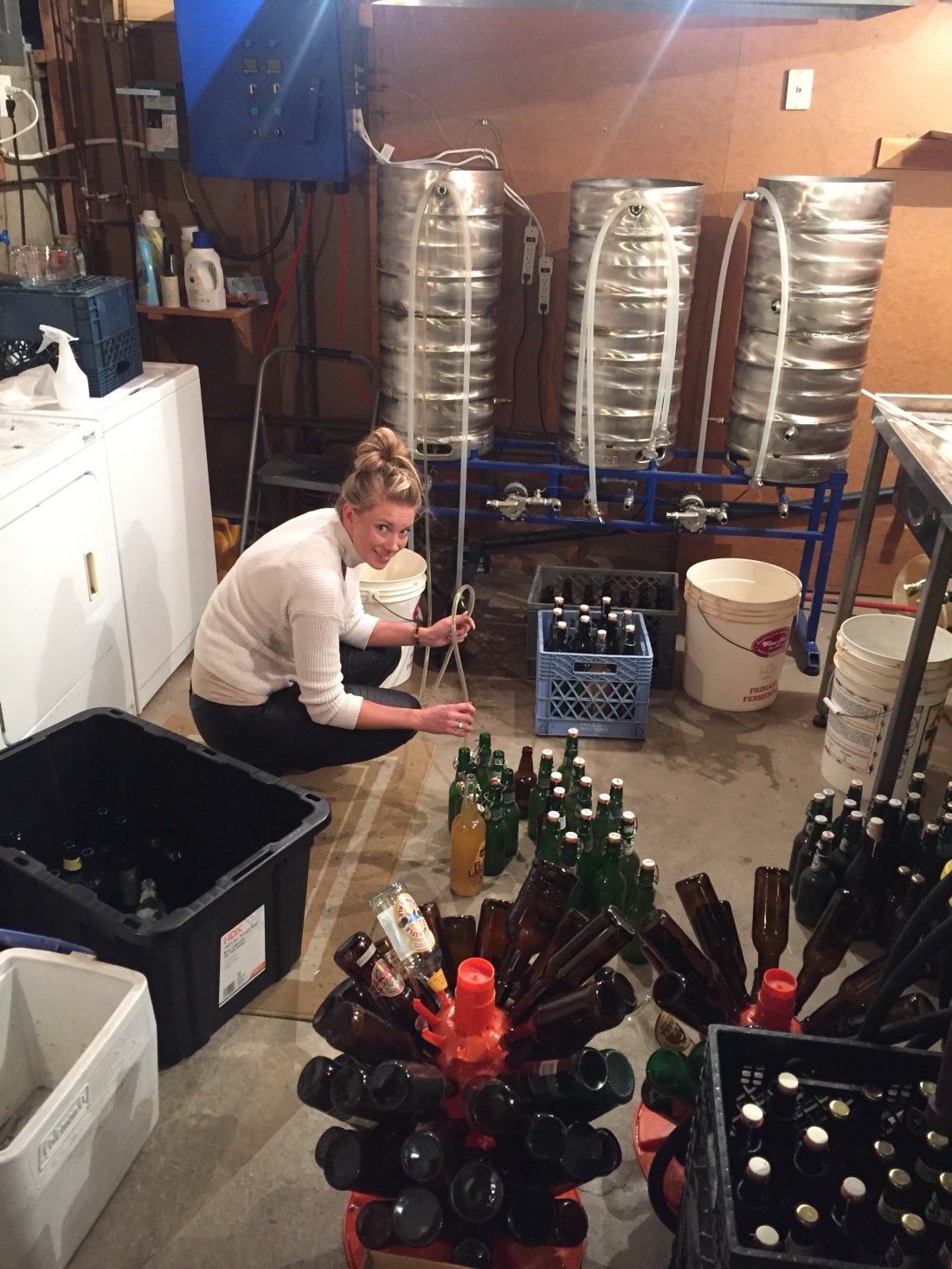
In his brewing craft, he started where most probably do, with beer kits.  Then, he transitioned to doing a few more steps on his own, and after his beer club informed him that if he’s using any part of a kit, he can’t really call it home-brew, he went 100% from the grain.  He literally buys a big bag of malted barley, grinds it himself, and does it completely from scratch.  The kitchen was no longer sufficient.  As he just happens to also be a custom welder, he spent the next year building a huge custom brewery in our basement laundry room.  He’s got 3 massive tanks that he welded, a custom counter and sink, heating systems, an electrical panel to run all of this, piping that hooks up to our laundry venting to the outside to eliminate the steam, numerous other equipment, and hundreds of bottles.

Needless to say, the laundry room is no longer a laundry room; we have a brewery with a washer and dryer in it.

We have a clean and empty backyard now that he’s out of the “tire side hustle,” but there were years when we barely had a backyard; we had a used tire storage facility behind the house.

Fast forward to the laundry room argument… pointless.  It’s not my laundry room, it’s our laundry room.  Can I wash clothes in there?  Maybe not while he’s brewing, but that’s where communication comes in.  It’s not my backyard, it’s our backyard.  Could I have hosted a beautiful garden party with all those tires out there?  Maybe not, but I hosted a pretty sweet birthday party and made the best of it.

So many women carry this idea that the house is their domain; at the very least, the kitchen, laundry room, and back garden are theirs.  The guys can have the garage, or the shed, or maybe some back room in the basement, where guests can’t see when they come over.  I don’t know why we think this, or why this idea is passed on to us by other women.  I don’t know why I just fell into that belief too, without even paying attention to it or questioning it.  I’ve realized over the years, that thinking this house is mine, because I’m the wife, isn’t very selfless or loving.  He doesn’t tell me I can’t park in the garage because he works in there; it’s our garage.  He doesn’t complain about the living room clock that’s a bright red high heel (it’s not tacky at all people, it’s a designer marble clock we picked up in Venice); in fact, he suggested we hang it there so I can see it every day.  We’ve also hung his motorcycle calendars in the kitchen.

It’s not my house, it’s our house.  And in this house, it’s about sharing, and compromising, and making this home a place that we both can put our stamp on, and that we both feel at home in.

I don’t know what this guy of mine is going to get into next.  I expect he’ll keep up the brewing, because he’s great at it, and he loves it.  I hope he finds more money-making hobbies, cause what’s not to love there?  Either way, he’ll be welcome to use our home, for what he needs it for, with no trouble from me; in return, I know I’ll be extended the same courtesy.
Aging Wine; The Need To Knows

“You get better with age like a fine wine…” ❤️

We’ve all heard sayings like this before that leave us to believe that all fine wine gets better with age.  This is partly true – many fine wines do get better with some age – but which wines are meant for aging and how long they should be aged, is actually quite a complex topic.  Then there are multiple factors that come into play regarding storage/cellar conditions that will either age wine well, or ruin it quickly.

A huge misconception I’ve come across in speaking with friends and family about wine is that it ALL gets better with age.  This is definitely not true!  There is a saying in the wine world that only 1% of wine is actually meant to be aged in the bottle, which means that 99% of the wine on the shelves right now is meant to be consumed within a few short years from now, or today!  More on specific aging times in a moment. I’ll tell you right now, that 1% more than likely didn’t cost less than $20 either, so if you’re hanging on to those $7.99 bottles, it’s time to grab some glasses, or possibly make dinner with some type of a wine sauce!

Wine needs to have certain qualities to give it the ability to age well.  Madeline Puckette, the creator of Wine Folly, gives 4 qualities that you can look for in a wine to determine if it is age worthy:  Acidity, Tannins, Alcohol Level, and Residual Sugar.  [1]

Acidity

The higher the acid in the wine, the better it will age.  When tasting wine, acidity is the factor that makes your mouth water.  It is often described as “crispness.”  Chablis, for example, has a high amount of acidity, and can age well, even though it’s made from white grapes. (Tip your chin down with the wine in your mouth and see how much spit forms. If there’s a lot, it’s higher in acid!)

Tannins

Lots of red grapes have high tannins and can be aged for several years.  Sometimes whites have tannins, but rarely.  Tannins are chemical compounds that come from the seeds, skins and stems of grapes.  When you taste them in wine, they’re not so much a flavour as a feeling.  (That dry feeling you get along your gums, like when you drink a way over-steeped tea, is the feeling of tannins!) In the process of making red wine, the grape juice sits with these parts of the grape, allowing the tannins to enter the wine.  Some can come from oak contact as well.  Certain grapes are more tannic than others, depending on their composition, and certain wines will be more tannic if they’re left to sit with the skins, etc. for longer periods of time.  These tannins can be bitter and harsh in young wines, but they help them age well because with time, the tannins “soften,” and become more “well-rounded.”  This basically means that instead of the wine tasting sharp and pungent in your mouth, it will taste more smooth and balanced; higher tannin wines need age to taste better.

Alcohol Level and Residual Sugar

Red wines with higher alcohol content, closer to the 14% mark, will typically age better than lower alcohol reds.  Whites have lower alcohol in them, but some grapes have particular compounds and sugar levels that will allow for a decent amount of residual, that is, left-over sugar, once the fermentation process is done.  These whites, like Rieslings, for example, have a balance of sugar and acid that enables them to age well.

So now that you’ve determined you’ve got a wine you’re going to hold on to, here are some things to think about before you put it away and forget about it.

Screwcap vs. Synthetic Cork vs. Real Cork  

The method of capping wines is still a largely debated topic in the wine industry.  Real cork, vs. synthetic cork, vs. screwcap – there are a lot of opinions out there on which is best and why.  For more information on this topic, check out my article Real Cork vs. Synthetic Cork and Screwcaps. For the purposes of this article, I’ll only comment related to wine’s age-ability and storage.

Australia and New Zealand initiated the use of screw caps, and still use them on many of their wines.  Other countries have started following suit.  A screw cap does not indicate poor quality wine, it’s simply a method that some producers believe is the best way to seal their wines.  Wines with screw caps don’t need to be laying down for storage, but they can be. Screw caps haven’t been tested for super long term aging, but some can last a decade or more.

Wine professionals have recommended to me, on more than one occasion, that synthetic cork should not be left in contact with the wine for long periods of time; they say it can leave a plastic type taste in the wine, and can also leave other synthesized compounds in the wine, that they don’t want to be consuming several years down the line.  Stand those synthetic cork wines up for any length of storage.  Fair enough. These are also only guaranteed for a few years at best.

Wine with a real cork must be stored lying down.  Cork is a natural compound, and it dries out over time.  By lying the wine on its side, the wine stays touching the bottom of the cork, and the moisture helps to keep the cork damp enough that it shouldn’t dry out.  This is important, because if the cork dries out, it shrivels up and shrinks, letting too much unwanted air into the bottle.  Over the years, the overdose of oxygen will ruin the wine, leaving it “oxidized” and undesirable. Natural cork has proven the test of time and has lasted sometimes for hundreds of years.

Cellar Conditions

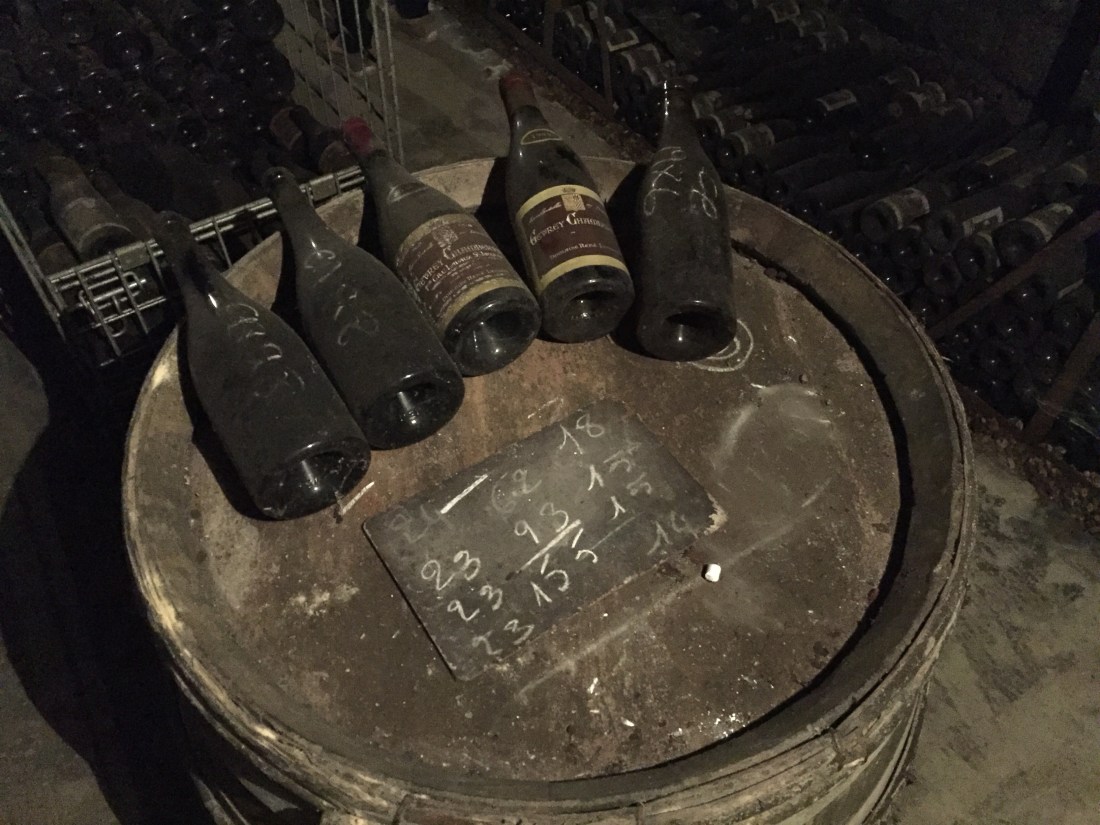
Have you ever been to a winery, or seen photos of their cellars?  What do you notice about them?  They’re usually cool, dark, and damp, and the wine is off to the side and out of the way so it doesn’t have to be moved.

Cellar conditions for ideal wine storage should be between 10 and 15 degrees Celsius, and shouldn’t change much.  Light shining onto the bottles for some time can alter the wine inside, whether it’s natural or artificial light.  Humidity will help keep the corks damp, so they stay plump and tightly sealed to the inside of the bottle’s neck.  The more you can leave the wine alone, without bumping it and moving it, the better its chances are of aging well.

When wine is resting well, it’s aging well, similar to you!  Just think of how well you would rest if someone kept changing the temperature on you, shining light on you, and bumping you around – exactly.  This is why I can’t sleep on an airplane. If you want your wine to be pleasant, give it a good rest!

Did you know that storing wine in a kitchen is actually one of the worst places in a home environment to keep it?  The temperature fluctuates the most in kitchens/bathrooms out of any of the rooms in your home.

How Long is Too Long?

There is a window of time that most wine professionals believe wine is at its best.  The window will vary slightly for each wine, but at a certain point, it will hit its peak, and begin to decline in quality again.  There is no exact way to know when this is, so it can feel like a risk when you’ve been aging a wine for a while, and want to make sure it’s at its best before popping that old cork ever so gently!

So many great wines become collector’s items, and people spend so much money on them, that they never want to drink them.  I once heard someone on a wine documentary say something to the effect of how many of the world’s greatest wines have essentially gone to waste, sitting in someone’s cellar for way too long, because people don’t understand how wine ages.  There’s a time and place for cellaring wine, but in the end, wine is meant to be drunk.

Jancis Robinson’s The Oxford Companion to Wine is one of my favourite wine books.  She says, “contrary to popular opinion, only a small subgroup of wines benefit from extended bottle aging.  The great bulk of wine sold today, red as well as white and pink, is designed to be drunk within a year, or at most two, of bottling.”[2]

In her expert opinion, she goes on to list specific numbers of years that several particular types of wine should be aged for, of which I’ve only included a few popular choices.  Almost all whites retailing under the $20 range should only be bottle aged to a maximum of 2 years.  Heavier whites, like Chardonnay can sometimes last up to 6 years.  More expensive whites can age longer, like Chablis (up to 15 years), or some Rieslings (up to 20).[3]  This has to do with the structure of the particular grapes, and how they’re produced.

Surprisingly, the number doesn’t differ much for reds.  If they’re around that same $20 mark or under, the longest Jancis recommends you keep them is 3 years.  You can hang onto higher priced French wines in your cellar from 15 to 25 years, Italian Chianti or Spanish Rioja can present nicely up to 10 and 20 respectively as well.  Above the $20 price point, most Cabernet Sauvignons can be bottle aged for 7 – 17 years, Pinot Noirs, 4 – 10, Shiraz, 4 – 12, and Grenache, 3 – 8. [4]  Jancis has not lead me astray yet, and I trust these numbers; keep in mind there are always exceptions, and your cellar conditions need to be appropriate, especially if you’re considering aging your own wines in the bottles.

*Note that keeping value wines up to that 2-3 year mark is NOT going to enhance their flavour; think of that time frame like a best before date.

To determine how long the wine has been in the bottle, you’re going to have to do some math!  The year on the label is the year the grapes were harvested, not the year it was bottled necessarily, so if the label explains that it was aged in the winery for a certain number of years, you can add that time to the year on the label to get the bottling year.

If you’re looking to age a wine, remember to look for wines that are balanced in acidity, alcohol, residual sugar, or have some tannin to them.  You’ll want to spend a bit more on these ones, and watch out for synthetic cork. If you’ve got a lot of $20 to $30 wines sitting in your house, it may be time to have a party!  Let’s not let that wine go to waste.  Happy aging of the appropriate ones, and cheers to all the rest of them!

[1] Puckette, Madeline.  (2017, Feb.)  “How to Tell If A Wine Is Age-Worthy.”  Retrieved from https://winefolly.com/tutorial/how-to-tell-if-a-wine-is-age-worthy/

[2] Robinson, Jancis.  The Oxford Companion to Wine.  2015.  Oxford, UK; Oxford University Press.

[3] Robinson, Jancis.  The Oxford Companion to Wine.  2015.  Oxford, UK; Oxford University Press.

[4] Robinson, Jancis.  The Oxford Companion to Wine.  2015.  Oxford, UK; Oxford University Press.

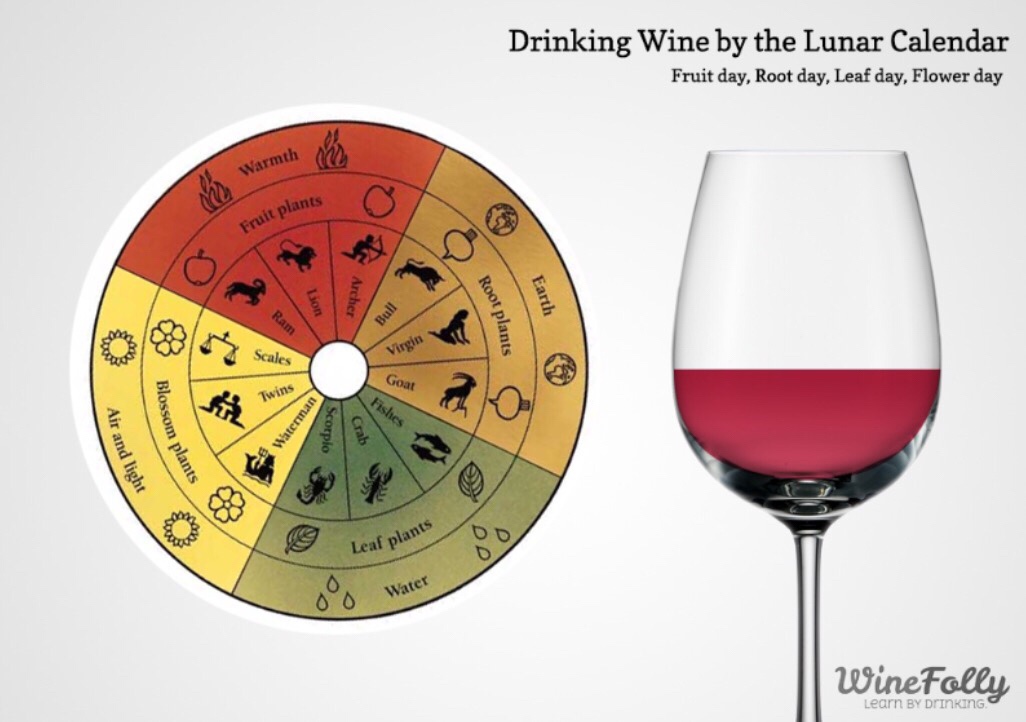
Red Wine Really Does Taste Better on Fruit Days 🍓 How I Put the Biodynamic Wine Calendar to the Test

I’ve heard it said that red wine tastes better on fruit days. First off, I can make my wine taste better? Second, what’s a fruit day? What does that even mean? Stay tuned and I’ll tell you all about it!

The biodynamic wine movement bases it’s entire operation on the lunar calendar. For vineyard practices, certain days are believed to be ideal days to water, prune, harvest, fertilize, etc. The lunar calendar doesn’t just determine when to do each vineyard practice; it’s believed that the lunar cycle affects us and our experiences of wine too. Biodynamic enthusiasts will tell you that wine will actually taste better on certain days than it does on others. This theory applies not only to biodynamic wine, but all wine. Crazy? Maybe. Maybe not!

Before you go discounting this whole idea, keep in mind that growing vines is essentially farming. The Farmer’s Almanac has used the lunar calendar for farming practices for decades, and if the moon can affect weather and climate patterns for other crops, it can certainly affect a wine crop, and potentially us!

There are 4 types of days the calendar presents: fruit days, flower days, leaf days and root days. These days are determined by the lunar cycle, so sometimes an entire day will be one type, and sometimes the type will change part way through the day! For example, it could be a fruit day in the morning and change to a leaf day at 2:00pm if that’s how the moon cycle was at that time.

Okay, so you might ask how on earth (or should I say on the moon) are we supposed to know which day is which?

Thankfully there are lots of handy calendars online. Here’s a link to one I like: https://ca.rhythmofnature.net/biodynamic-calendar.

Alternatively, you can download a biodynamic calendar app (the only one in the App Store), but you have to pay in order to see ahead in the calendar, which with my planner personality, I don’t like.

Enough moon talk. Let’s get to the wine!

According to the wine tasting theory, red wine is supposed to taste best on fruit days, and white is pretty freaking great on flower days; awesome!

🍓 🌺

Apparently both red and white are supposed to be less enjoyable on leaf days and root days. Boo.

🍃 🥕

I’ve read articles written by people that have tested the theory and found it to be true, and others who think it’s a complete joke. I love a good experiment, and drinking wine, so naturally, I had to see for myself! My husband did the experiment with me, and we found that red wine actually did taste the best on a fruit day!

We took this experiment pretty seriously, so before you judge me as completely off my rocker, have an open mind and read on.

Here’s our experiment:

Hypothesis:

I figured we’d each agree on our enjoyment of the wine for no more than 2 of the days, and that we would not be able to peg the fruit day specifically. (I clearly had little faith in this theory!)

Materials:

  • A good friend to determine 4 blind tasting dates for us (as I couldn’t check for myself in order to keep them anonymous)
  • 4 bottles of red wine of the exact same producer, grape, and vintage (the control) 🍷 🍷 🍷 🍷
  • Wine glasses (cause drinking from the bottle’s just not classy)
  • Pen and paper (and an ability to keep secrets!) ✏️ 📝
  • Open minds (reader, you need this too!)

Procedures:

I wanted this to be as legit as possible. I had my friend, Ivy, check the biodynamic calendar and select 4 days during my upcoming holiday. She checked 2 calendars just to be sure, and gave me 4 dates that covered each kind of day, without telling me which was which. (Very secretive!)

I wanted to do the whole experiment on holiday so that I would be in roughly the same type of happy mood each day (which ended up slightly failing, as I’ll explain below).

We selected a type of wine that we don’t normally drink a tonne of, (yes, it was difficult, but we found one) and a producer that we had never tried before, so that we wouldn’t have many past experiences to compare the wine to.

We purchased 4 bottles of the same wine, so that each day we could open a fresh one. Have you ever tried week-old opened cheap red? Yikes! Don’t! This way there could be little risk of the taste having changed from oxidation over the course of the week.

We made sure to chill them each to the appropriate temperature range, and to drink the experiment wine first, before any other wine or food that evening (to ensure we were of perfect clarity of mind and palate).

We each kept notes of our level of enjoyment of the wine and gave it ratings based not on quality, but on how we felt it tasted (as that was the goal of the experiment).

We did not peek at the biodynamic calendar at any time. (No cheating!)

Lastly, we did not discuss the wine with each other at all until the whole experiment was done. No tasting notes were given, not even if we liked it or not, nor any guesses or comparisons – we said nothing, to keep it completely subjective. (As wine education lovers this took incredible self-control!)

(Image from winefolly.com)

Results:

Upon comparing our notes, we both felt the wine wasn’t that great on Day 1, which turned out to be the root day. My husband gave it the lowest score, and I gave it the second lowest score on this day. Interesting! 🥕

We were in between on our opinions on Days 2 and 3, which ended up being the flower and leaf days, however I must add that I gave it a high-ish score on Day 3, the leaf day, as I drank it in the first good sun tanning weather I’d had on the trip. I believe the perfect weather probably affected my emotional experience of it – I was really happy when I drank it! It wasn’t very complex that day, but it seemed enjoyable. This goes to show that environment and mood also affect enjoyment of wine. 🌺🍃

Finally, we both pegged the fruit day right on! 🍓

On Day 4, we had just had an afternoon nap, woke up before a dinner date, and it was raining, but we knew we had to taste the wine before we could go out! It shouldn’t have tasted good in that setting, but it was immediately, upon first sip, the best and most complex it had tasted to both of us during the entire experiment. This was mind blowing to me, because I was not expecting to actually notice that much of a difference! Once we looked up the days and realized it was the fruit day, we were both shocked that it was noticeably better for both of us on that day, without us knowing any better or speaking to each other about it.

🍓🍷✔️

This could be one factor to explain how sometimes a wine is so good, but when you open the same one the next time, it’s not as good as you remember, or vice versa.

Based on my results I’d absolutely recommend saving higher priced red wines to drink on fruit days, or at least when you’re in a fabulous mood!

Further Experimentations:

I want to try this with whites, and see if we can peg the flower day. 🌺

I also will choose dates for my friend, Ivy, and her husband to do their own version of the experiment to see what kind of results they get. 📝

If you think this is all complete BS, that’s fair. I honestly did too. Now, I’m open minded to it and will be paying closer attention! ✔️

I challenge you to try it for yourself. You might just be surprised! At the very least, you’ll have some bottles of wine with someone you like, and that’s pretty great in itself.

Happy fruit and flower days!

🍓🌺

An Ode to a Stupid Dishwasher

Dishwasher, dishwasher,

I remember the day

When you came along

And sent our old, ugly one away.


You were bright white, and working

A high end gift, you were free,

You matched our kitchen already,

What else could there be?


I guess when they say

That you get what you pay for

They weren’t wrong about you,

For you’ve now dumped all over our floor.


The mess that you’ve made

Both upstairs and down,

Is quite a frustration;

You’re making us frown.


Of course, you waited to break

Until we were away for two weeks,

Because what a nice welcome home

To arrive to a huge freaking leak.


You’re costing us a lot

In both money and time,

For we now need to replace you

And clean up your slime.


Oh stupid dishwasher,

You’ll be on your way

Just as soon as we find

Your replacement, I’ll say.


This time we won’t

Look for one that is free,

But instead find a new one;

Let’s hope it won’t pee,


All over the tiles,

Walls, ceiling and rug,

Then just sit there all

Bright white, clean looking and smug.


It’s unfortunate that you add to us

Unnecessary extra cost

When we’re trying to find renters,

A search bringing us exhaust


At least you did this now,

To us and not them,

So we can kick you to the curb,

And not leave it to a friend.


So stupid dishwasher,

Good riddance and goodbye,

Now let me get to the sink

And do your job just fine.

Organic and Biodynamic Wineries in Kelowna

Organic wine is becoming more and more of a trend in the new world. It’s quite commonly found in Europe, but it’s still a rarity in Canada. Kelowna has several wineries that use some organic practices and that claim to be organic, but there are only two that are actually certified Organic, and one that has a Demeter biodynamic certification. We visited both of them, and loved our experiences at each! I’m pleased to share with you what we learned about their practices and what we thought of the wines at Summerhill Pyramid Winery and Rollingdale Winery. First, it will help to understand what makes a winery organic and biodynamic.

There are several reasons why people are growing fond of organic wines, such as their low sulphite content, and environmentally sustainable practices. Many wineries may use organically grown grapes, but as nice as this theory is, if the winery isn’t organic in the rest of its production, it’s not putting out an organic product. In order to be certified organic, there’s actually quite a process that a winery has to successfully complete. Each country has its own specific regulations for certification, but they all focus on producing the purest wine possible. Grapes need to be grown organically, with no chemical sprays used. The organic vintner doesn’t add commercial yeast, but rather, lets the natural yeast in the air and on the grapes do the work. Sulphur naturally occurs on grapes in small amounts, and it is often used to sanitize bottles, but an organic winery is not permitted to add sulphur to their wines to stop the fermentation process, and they have specified maximum sulphur amounts on reds and whites. This means that sulphites (the buggers blamed for those nasty headaches and hangovers) are going to be minimal compared to commercial wines. Many organic wineries often don’t do fining or filtering, which means they’re not putting animal protein by-products (like fish bladders or egg or milk proteins) into the wine to clear out the sediment; you’ll notice some chunks at the bottom of your bottle of organic wine. This is the leftover tartaric and other acids, dead yeast and bacteria. It sounds kind of gross, but this is part of the wine making process, and they’re in all wines during fermentation. Most commercial wines take them out using chemicals or all those animal parts I mentioned (the sediment coagulates onto them), so I’m fine with seeing the sediment in my glass to know it’s a cleaner product.

The biodynamic movement is gaining more traction as people are studying it and starting to notice positive effects in the vineyards and the wine. The movement basically involves using the lunar calendar to determine the best days for vineyard practices, as well as some other beliefs that certain plants and natural practices increase the overall health of the vineyard, and therefore the final product that it produces. Biodynamic wineries are always organic wineries first; biodynamics is a way of being even more environmentally friendly, and additionally, these types of wineries are usually paying attention to sustainable practices to reduce their footprint on the earth as much as possible.


Now, to the wineries!

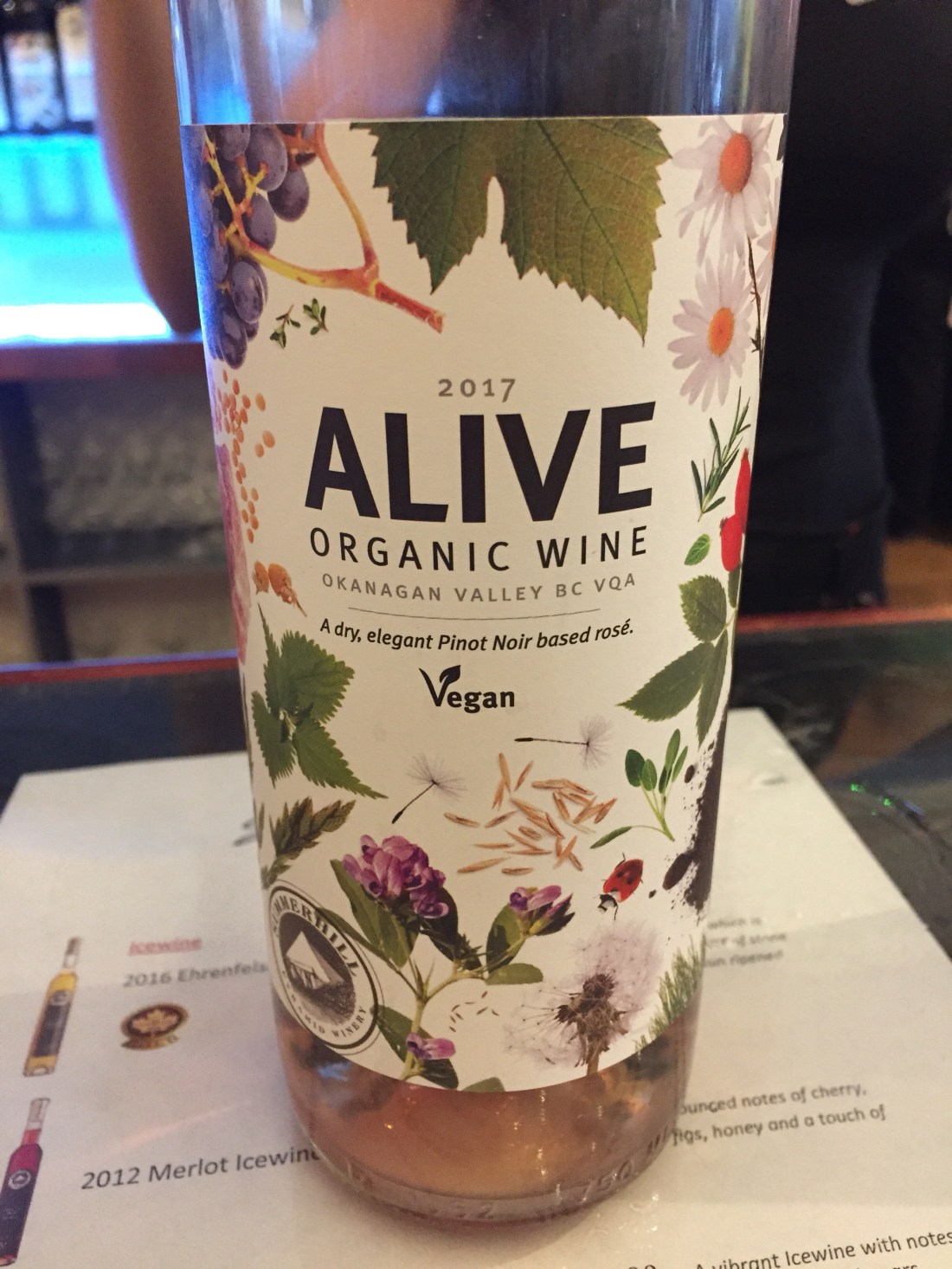
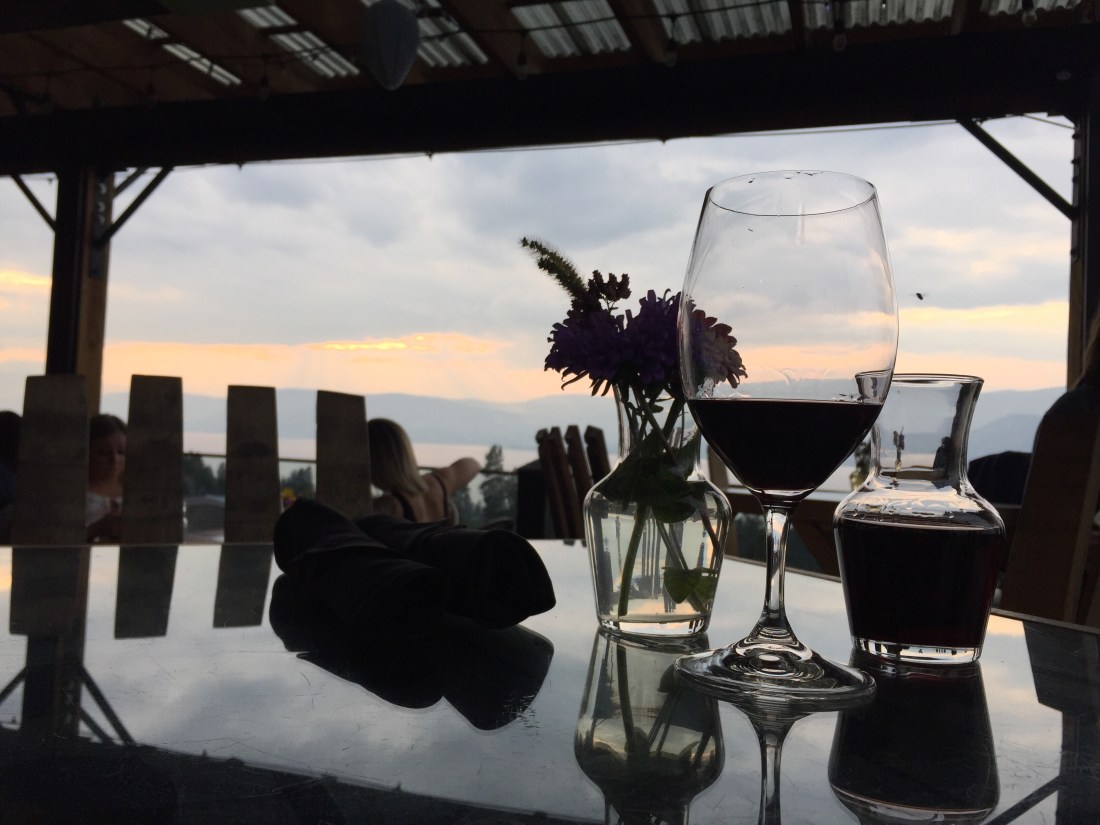
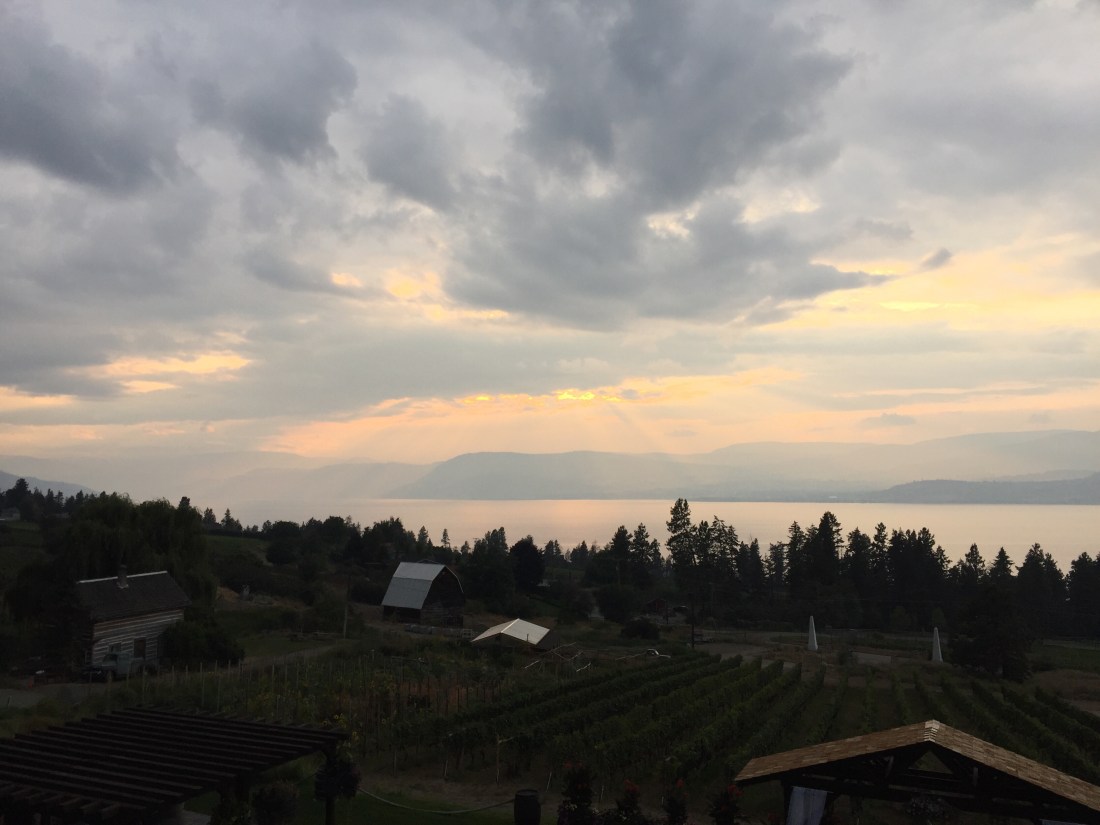
Summerhill Pyramid Winery is located just outside of Kelowna on a hillside overlooking the mountains and Okanagan Lake. Summerhill is certified organic and biodynamic. All of their wines are organic, and two are biodynamic. They are a large winery with lots of room for tasting, special events, and enjoying the beautiful view from inside and out. They have a large patio area that is part of their restaurant. We started with a tasting of several wines before we made our way to the patio to relax with a glass.

We started with their sparkling wine, which is made from Chardonnay and tastes as similar to Champagne as we had in the Okanagan valley, anywhere. It is made in the traditional method, with a traditional Champagne grape varietal, and we were quite impressed with it. It has notes of crisp green apples and citrus, and a slight yeasty bready nose and flavour.

Their Viognier was also notable as it was quite floral and aromatic, and was a great expression of what the grape should taste like, as was their Alive Rose.

This is a benefit to organic wine, with little intervention; it can taste like what the grape actually offers, rather than what the winemaker did to it to alter the taste to what he or she believes consumers may want. We tried several more wines, and weren’t in love with all of them, but overall, we were pleasantly surprised. Our sommelier was an Italian man who recently spent some time in South America, and he had lots of experience and knowledge to offer about wine.

On the patio, we enjoyed Syrah and Merlot, two more that we felt were great representations of the grapes and well done. Our service here was also excellent!


Rollingdale Winery is special to us because we’ve gotten to know their wine maker over the course of our visits in which we’ve connected on lots of common ground. We therefore know even more about Rollingdale’s practices than we do about Summerhill’s. Rollingdale is certified organic, and is currently in process of becoming biodynamic. All of their wines are organic.

Rollingdale is set up in a very casual, minimalistic style. It’s rustic-industrial-chic, if you will! They’re using a shop as their winery and tasting room, and they don’t have a restaurant or a fancy patio, but visitors get the sense of being on a family farm, and that’s how they treat you there – like family. Everyone is so welcoming and friendly. They have a little cheese and cracker set up when you come in, and juice boxes for kids, and when they go through the wines, you can tell they’re passionate about what they do, not just punching a clock.

Our sommelier took us through several wines with an explanation of each, what they were made of and how, and a bit of the stories behind the names. He was knowledgable about the wines and the winery.

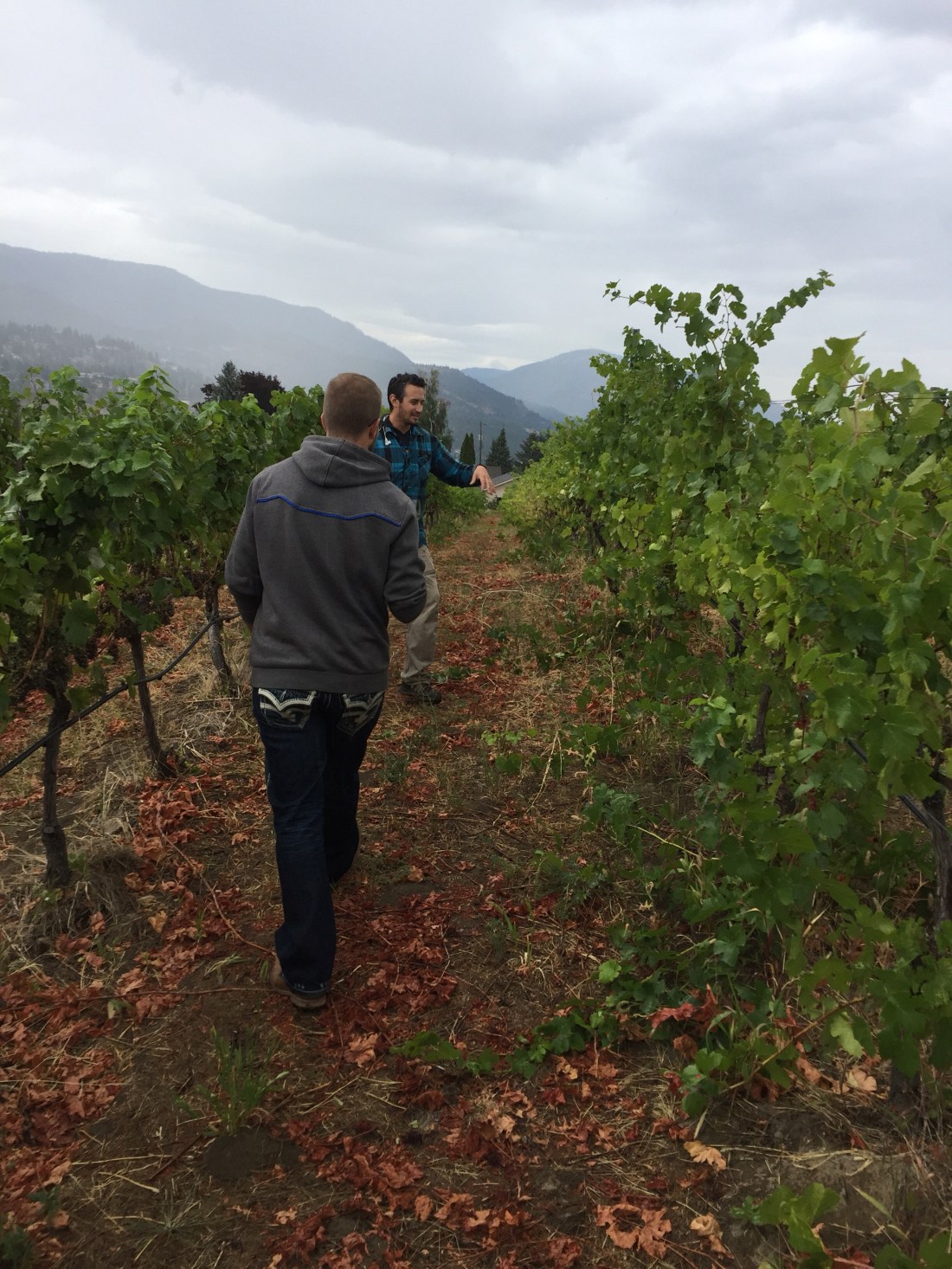
After our tasting, we ran into the winemaker who took us on a long walk through the vineyard and showed us where they were at in the season. He also explained how they’re in the process of getting their Demeter biodynamic certification. We went and took a look at the biodynamic block to compare the crop with the others, and it was immediately clear how much bigger, more ripe and abundant the fruit was. After going through the process, he really believes in the practices, now that he’s seen them for himself.

He has to keep a daily log of everything he does to those grapes and vines to get the certification. There are only certain days on which he can water and harvest, and he has to track exactly how much water the vines get. There are other days they’re permitted to prune and trim the vines. There are certain plants that need to be growing on the property to increase the health of the whole vineyard’s ecosystem. They have been taking measures to draw certain birds to the area to control pests naturally. They spray the crop with steeped teas of particular herbs and plants. There’s so much going into it, but it’s going to be worth it based on how those grapes looked yesterday! I’ll be excited to try their 2018 biodynamic Chardonnay!

(Pictured above: smelling hops, and taking a look at some of their fruit plants)

If you’re in the Kelowna area, and looking for a fabulous tasting experience, try either Summerhill or Rollingdale, or both! I highly recommend them, as you’ll be supporting more environmentally friendly wineries, and getting a more pure product in addition. If you have never tried organic or biodynamic wines, I encourage you to do so. See what you think of them, and how they make you feel.

Happy organic wine-ing!

Why You Should Try Walmart and Truck Stop Camping

I love Walmart Camping for several reasons. Years ago I saw the campers parked at our city’s Walmart, and it looked like such a fun thing to do. I’m really not sure what drew me to the idea, other than maybe how carefree and spontaneous it looked. At that time, the camper we had didn’t have a bathroom in it, which for me, is pretty important on my needs list.

Fast forward a few years to when we had a camper with a functioning bathroom, and a generator, and planned a last minute trip to BC – Walmart Camping became something I crossed off my bucket list! We had just been in the British Aisles that summer and it was so cold there, so we literally decided in the airport on our way home to head to Kelowna with our trailer for a week of hot, sunny weather before summer ended. We arrived home at midnight and left town by 8am the next morning! We had our camper on the back, and nowhere booked to stay.

We spent the first night at a truck stop, and the next three between two Walmarts in Kelowna, and it was great. Since then, our family members have started Walmart Camping a bit, and we’ve done it several more times. Here are the pros and cons to staying at Walmart and truck stops:

Pro’s:

1. It’s Free. This is a major plus, especially if you’re just driving through a place, and you don’t need to spend much time there. It feels like a waste of money to book an RV park just to sleep.

2. It’s Last Minute. This could be seen as a con for some people, but the benefit of sleeping at Walmart is that you don’t have to book ahead. We like to drive until we feel like we’re done for the day, and then find the next Walmart or truck stop, and pack it in for the night. We don’t always know how far we want to make it, so booking ahead is a problem for travel days. Last minute stops allow us freedom in our traveling and make it much more relaxing than, “we’re so tired but we have to make it to that city where our booking is tonight,” or “it’s so early, and we could have kept driving for hours if we didn’t have this booking here.”

3. You can shop! We often need either a couple small grocery items, or something for the truck or trailer, and Walmart has it all. Most have a tire shop too, which is great for being on the road.

4. Starbucks. So far, at every Walmart we’ve stayed at, there has been a Starbucks within walking distance for me to go pick up my mobile order in the morning. It’s awesome. Not to mention, there are usually lots of other stores and restaurants nearby as well.

There are a few downsides too.

Cons:

1. You’re not level, or set up. Since you’re not unhooking your vehicle for any length of time or at all, or putting your jacks down (or shouldn’t be) you can’t level out, so we sometimes sleep with our heads or feet higher than we’d like. Just do your best to find a flat spot when you park in their designated area. You can’t set up full camp either, so you’re living in limbo a bit.

2. It can be bright and loud. As it’s meant to be an overnight thing, don’t plan to sleep in. Walmarts are always in high traffic areas, so there’s going to be noise from that. They also have bright lights that illuminate the lot overnight. Patrons start showing up early to shop as well. We’ve had some Walmart mornings where people park right by us and are walking past on either side to get into and out of the store. Truck stops will be loud as the semi’s are coming and going all through the night, and most drivers leave their trucks running while they sleep to control the temperature inside.

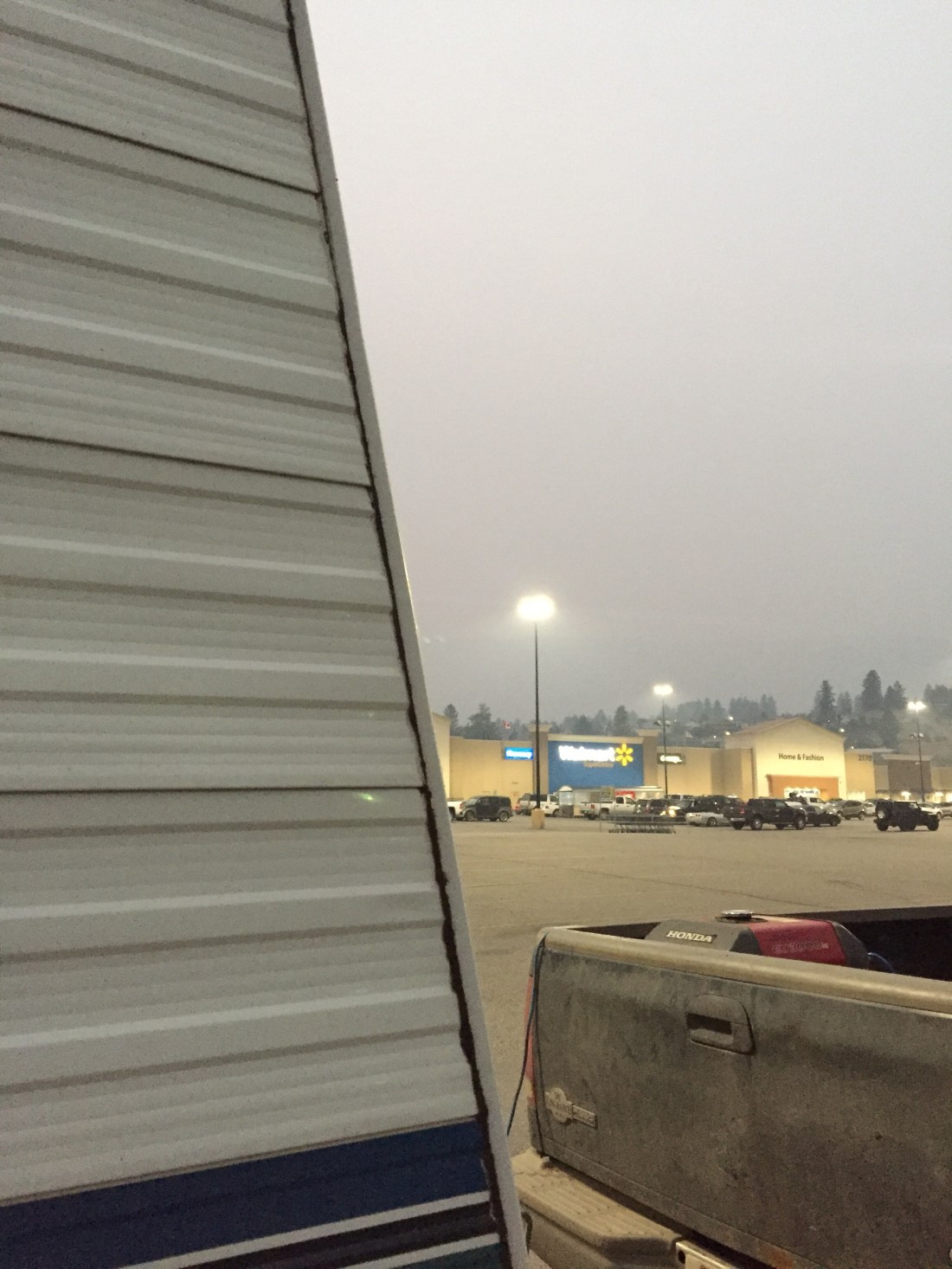
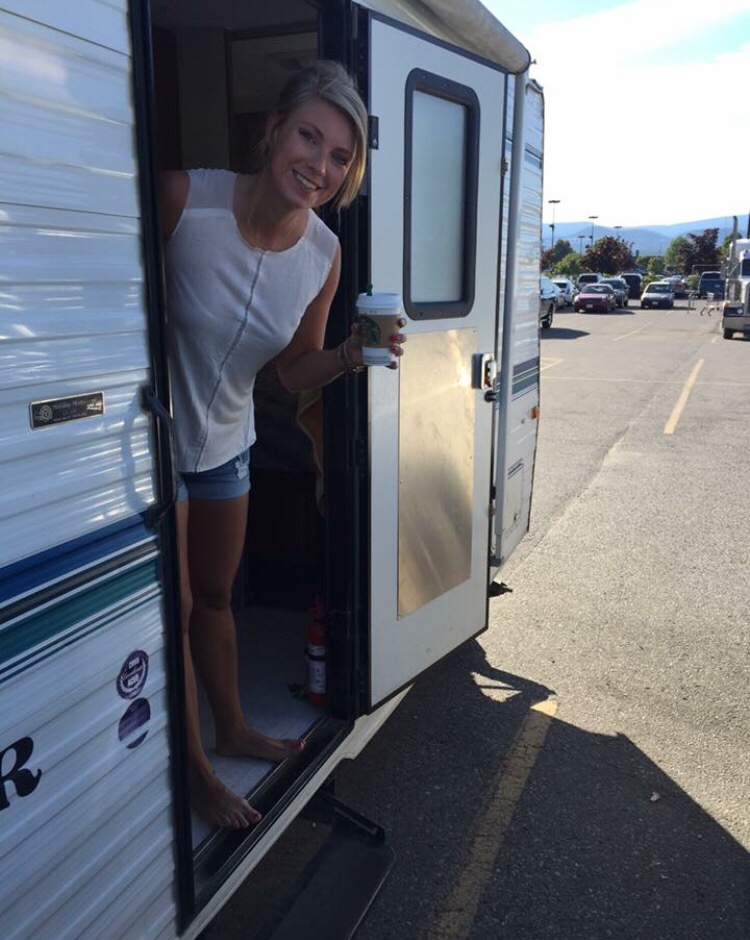
3. You can’t leave your trailer there unattended and you shouldn’t unhook. (I know, in the picture just above we’re unhooked! On that day we did this to block the spot next to us because a super huge and loud motorhome bus had squeezed in beside us the night before and ruined our sleep and space. This is potentially another con – you have to deal with other RVers who may or may not be cool, but you do this at RV parks too). You’re really only supposed to spent one night, or maybe two, but they don’t want you actually camping in their lot. It’s meant to be an overnight rest stop.

That means that when we Walmart camp, we take the trailer behind us everywhere we go during the day. This gets to be a bit of a pain after a while. Walmart Camping is great for a few days, or for when you’re driving to and from your destination, but it’s not ideal for long term stays.

4. No hook-ups or dumps. This isn’t really that big of a con, but it needs to be mentioned. Make sure the appropriate tanks are full and empty before you go, and that you have a generator if you want power. There should be a dump at a service station in town somewhere. If you google it, you can find it, but it’s not likely to be at Walmart or close by.

Despite the short con list, the pros way over-deliver for us and we still camp at Walmart or truck stops on nearly every road trip.

We usually do steaks, or a nice meal for supper, and a pancake breakfast too, because who says you have to eat bad food just because you’re staying at Walmart?

One more brief, yet important point! Make sure you call ahead to ask for permission, because not all Walmarts allow camping! Many have terminated the offer due to people being idiots and leaving dog poop or trash behind, or even emptying their tanks in the lot! Who does that? Don’t be an idiot. Super-centres are a good bet to stay at, but we’ve gotten a courtesy ticket for staying at a Walmart in a mall before. Run inside to buy something or fuel up as a thank you if you’re sleeping at a truck stop.

Happy Walmart Camping!

Broken Down Lessons

I love that feeling when we first hit the highway, the camper’s on the back, we get a good song on in the truck, it’s dusk and we’re hitting the night driving, and my husband’s just cracked the bag of spits – now it feels like holidays.

Then the truck breaks down before we even get to our first option of where we want to spend the night…

I’m a very reflective person. I know I over analyze things sometimes. I’m always looking for the hidden meaning in every situation. “Why did this happen?,” is often the first response I have to anything unexpected, and perhaps that’s a normal response. I had some time to reflect while my husband was outside on his hands and knees in the engine with a flashlight pulling the truck apart last night. With the truck broken I am reminded of a few things that are symbolic of life to me. Here’s what I can learn from this hiccup in the journey:

1. We can make our plans but the Lord directs our steps. That seems simple to understand, although it’s not always easy to accept. No matter how much we think we’re in control, we’re never really in control.

2. It’s interesting how one part in a vehicle can break and it stops you completely. The truck can not run when even one small piece is broken or missing. That tiny piece not functioning in the way it was designed caused our entire journey to end until it was repaired. This reminds me of our overall health. When we let one thing go, even if it’s so small, it affects the whole of our being. When one area of our lives is out of balance or in disrepair, it taints our effectiveness in every arena of our lives. Even more, it’s often the little things that we wouldn’t think are a big deal that can stop us up completely.

3. It didn’t matter how many hours my husband spent working on the truck in the dark last night; when you need a part and don’t have it, there’s nothing that will work until you get it. We spent the night in a farmer’s driveway on the side of the road until our friend was able to come in the morning with the part. As soon as those guys had it in, it was so quick, and we were on our way again. Sometimes I try and do a quick fix, or I solve a surface level problem in my life without getting to the source and repairing what’s actually damaged. This ultimately is a waste of my time, because until the piece of my life that’s broken or off balance, or unhealthy is replaced with something new, whole and functioning, I’m not going to actually get anywhere. Also, sometimes you just need help from a friend.

4. The farmer came home and had to take an alternate route into his yard because we were in the driveway obviously having vehicle trouble at midnight. He did not come and check on us at all, or see if we needed a tool or any help. This makes me thankful for my helpful friends, and also, for my in-laws! They are such a helpful family, and if the situation were reversed, any one of them would have been out there helping the people with anything they needed, and telling them that of course they can sleep in the driveway! My mother-in-law would have likely invited them for breakfast, too. I’m thankful for helpful, kind family and friends in my life.

5. It’s definitely easier to fix vehicles in the daylight than in the dark!

How We Rode a Willy’s Jeep through the Vineyards of Chablis

We recently took a trip to the wine regions of Chablis, Bourgogne, the Cote Rotie, and Hermitage.  We celebrated our 10th anniversary in Paris, and as my husband and I just recently took our WSET Level 2, he planned this nice, five-day wine tasting add-on as a surprise that I must say was very, very pleasantly received.  Today, I’ll discuss one special tasting in Chablis.

First things first – the cutest little red and white Citroen!

Trains are a great way to travel around Europe; they get you easily out of and into the hearts of the cities.  If you’re going wine tasting though, you need to have some method of getting into the wineries, which are often in small towns, or out of town.  You have a few options of hiring drivers or signing up for wine tour vans and mini-buses, but we like to be independent, so we usually prefer a car of our own.  We knew from research that the French don’t appreciate it if you swallow their wine at a tasting. “You taste wine with your mouth, not your stomach,” is a common French philosophy, and we get it.  They’re pouring you some really nice wines, and if you’ve consumed the first five at their place, and who knows how many others at the place before, they know your palate isn’t exactly what it was when you woke up that morning, nor is your mental clarity.  As we were clearly planning to befriend the spittoon at every facility, driving was not going to be an issue.

We flew from our small city in the prairies to Toronto in the afternoon, then took the red eye from Toronto to Paris, arriving around 8am.  We had to drive through Chablis on our way to Dijon, the town we had our Airbnb booked in.  I’ve travelled enough now that I know myself pretty well; I said to my husband prior to the trip that no matter how tired I’d be from flying, as soon as we got there, and were driving through Chablis (me saying, “oh my gosh, we’re in Chablis right now!” over and over), I was going to want to stop at a winery, or a chateau as they call them, and stat!  I knew I wouldn’t want to wait a day, so we made a couple of bookings for Chablis before we flew out (more on bookings later).

We rented the Citroen, and once we figured out how to change the GPS from German into English, we were on our way to Chablis!  After filling up on baguettes and prosciutto from a grocery store off the highway, we arrived at Clotilde Davenne where we were in for a real treat.  They recently began offering a Willy’s Jeep tour through the vineyards of Chablis, and we were their first customers to book the experience.  We climbed up into the old Jeep, with Arnaud, the winemaker and owner’s son driving, my husband riding shot-gun, and myself in the back, hanging onto whatever I could find as to not fall over the side, and boy was it a ride!  If you’ve ever seen pictures of Chablis, it’s not flat; I had some moments of sheer terror where I was bounced off the seat, or I imagined going over the edge or us rolling, but I was so thrilled to be riding in Chablis that I got over it pretty quickly.

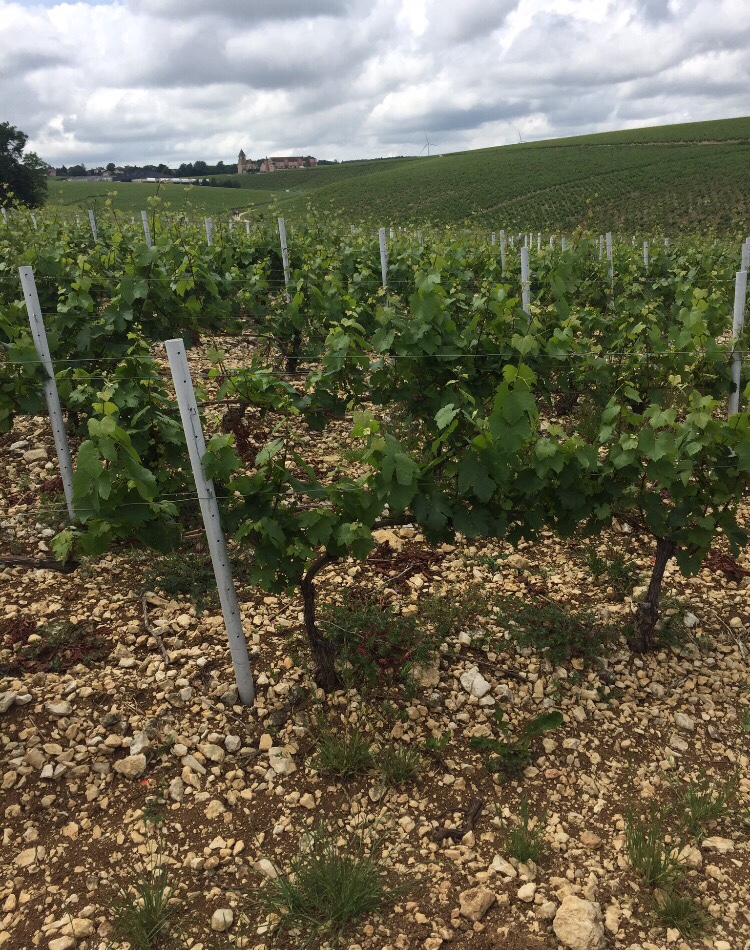
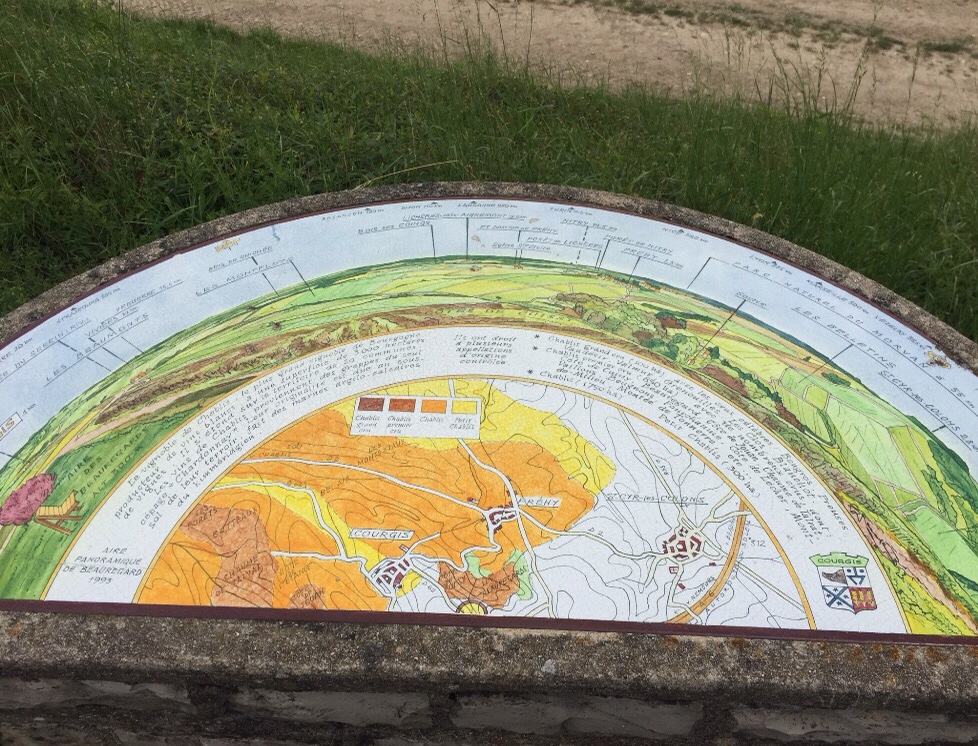
First of all, this jeep was used in WWII to transport soldiers, and if that wasn’t amazing enough, we were driving between rows and rows of perfect Chablis vines, setting our eyes on the very slopes of the Premier and Grand Cru grapes of arguably the most reputable Chardonnay in the world, with a second generation French winemaker as our guide.  “Here are some Premeir Cru plots, and over here are the Grand Cru plots…”  If you wonder why Grand Cru is so expensive, it’s because out of the 6000 hectares of vineyards in Chablis, only 100 hectares are Grand Cru plots, meaning that only the grapes that come from those specific 100 hectares can be labelled as Grand Cru.  The land is Grand Cru because of several reasons, some of which include the direction it faces which affects sun exposure, the slope of the hill affecting sunshine and water uptake, the soil make-up, the depth of the roots, the age of the vines, and the history that those particular vines have in producing the best quality Chablis.  Arnaud took us to a viewpoint at which we could overlook the vineyards, and see a map of Chablis on a stone plaque that labelled all of the individual plots and their level of quality in an easy to read, color coded system.

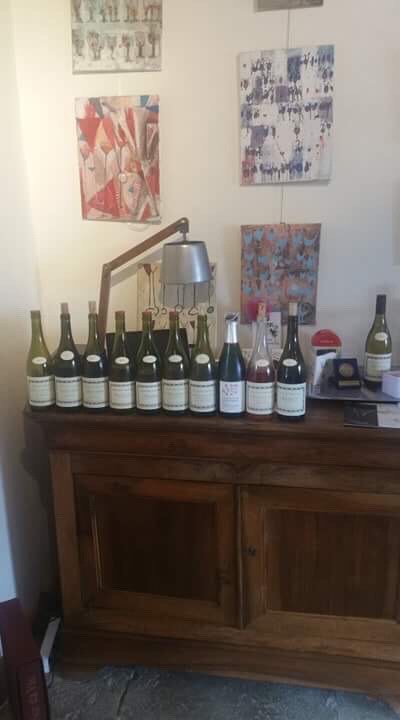
Once we finished our tour of the land, Arnaud took us back to the chateau for a tour of the grounds, a history lesson on his family and how they started in the industry, and a tasting.  He spoke fairly good English, which was great for us, as we speak little to no French.  We began with about six wines on the table, and once he saw that we were spitting them out, asking detailed questions and taking the tasting seriously, we ended up with another four.   We tried all four levels of Chablis: Petit Chablis, Chablis Villages, Premier Cru Chablis, and Grand Cru Chablis.  These are all quality, Chablis Chardonnays, but they’ve been aged differently, and for different lengths of time, and they come from the specific plots of land that coordinate with their specific level of quality.

If you’ve ever had a bad Chardonnay, or heard the saying, “ABC – Anything But Chardonnay,” you’ve probably had experience with super oaky ones, or butter bombs, but Chablis is nothing like that.  It’s crisp and refreshing at all levels, and the higher levelled ones are extremely complex, with multiple smells, and tastes that linger in your mouth and change over the course of the next 15 or so seconds after you’ve swallowed (or spat).  You’ll get lemon, crisp green apple, citrus and floral blossoms on the nose, and there is a distinct minerality to it, kind of like a wet stone, limestone taste to Chablis that comes from the limestone soil the vines call home.

We also got to try some wines from other plots in the family that were really interesting, like some Pinot Noir Roses, a sparkling Cremant (made in the same way as Champagne, but wine can’t be called Champagne if it’s not grown in Champagne), and the Bourgogne Aligote, which is the only other white grape that’s allowed to be grown in the Bourgogne region, and is used often as a table wine or a blending grape.  The most interesting wild card we tried was the Roman grape that Caesar used to drink, and was therefore named after him.  This is grown in the Irancy region, therefore the wine is called Irancy, (regions are how France labels their wines), although it’s 10% Caesar and 90% Pinot Noir.

ALL of this – for the very reasonable price of €20 each.

Needless to say, we picked up a few of our favourite bottles to take with us, and gave Arnaud and Clotilde Davenne a spectacular review on Google.  I would send anyone there, so if you’re ever in Chablis, look them up!

A note on bookings in France:

Always book ahead at the chateaus in France.  The website that we used, ruedesvignerons.com, helped immensely.  I did have a couple of glitches with their app when trying to cancel or change a reservation, so it’s not perfect, but it is a great starting point for booking.  It shows which wineries are visitor friendly, because not all are open for tastings to the public.  It also lists information such as the different times available, types of tastings, and the costs.

We found that when we showed up at most chateaus in France for our bookings, we were the only ones there.  The families live and work on the property, and they’re the ones that run lots of the tastings and tours.  They’ve got work to do; they’re not sitting around waiting for people to walk in the door.  If you don’t book, there’s a chance the door will be locked, and nobody will be around.  If you do book, they’ll be there waiting for you, having already learned your names and set up the tasting, just for you.  Be sure to let them know if you need to cancel!

If you ever have the opportunity to taste in Chablis, or to taste anywhere in this world for that matter, go for it.  You can meet some of the greatest people, and get to share in a small piece of their story, their craft, and their passion.  Especially in Europe, it’s an amazing thing to be a part of.

Happy wine-ing!

Summer Yoga Experiment – Week Four

After four weeks of Yoga, I agree that there is a physical, mental, and spiritual component to the practice.  In my first Yoga blog, I focused a lot on the physical, and somewhat on the mental; I’ve concluded that Yoga has great physical benefits for me, and some mental benefits.  As I have continued practicing Yoga, writing about it and participating in discussions that have come from my blog posts, I can’t deny that the spiritual aspect of Yoga is a large part of it, or at least, its roots.  The spiritual aspect is largely what I’ll be addressing in this final post.  I was able to get some spiritual benefits from my practice; however, I don’t believe the spiritual benefits were something that I could only get in Yoga.  I believe they resulted from personal intentions of what I chose to focus on for a dedicated amount of time in a quiet space, something I could do (and have done) in other environments as well.

“Yoga is not synonymous with Hinduism…True Yoga neither competes with nor precludes any other religion.  You may use your Yoga – your disciplined practices of sacred union – to get closer to Krishna, Jesus, Muhammad, Buddha, or Yahweh…The Yogic path is about disentangling the built-in glitches of the human condition, which I’m going to over-simply define here as the heartbreaking inability to sustain contentment” (Gilbert, Elizabeth – Eat Pray Love – p.122).

You may not believe the Bible, but I do, and there are some verses that I love in there that support contentment and discipline. Here’s one:

Romans 12:2a “Do not conform to the pattern of this world, but be transformed by the renewing of your mind.”

Some might use this verse to suggest a Christian shouldn’t go to Yoga.  I’m proposing the opposite; if Yoga helps someone break away from discontentedness and other “built-in glitches of the human condition” because we are so distracted with our lives, then it could be helping us focus on things that actually matter, and it could be used to renew our minds.

I completed my final week in my Yoga experiment with another evening class of Hot Yoga, with my husband in attendance, and a fourth new teacher.  Guess what?  She was different than all the others.  She had her own style, and there were things I liked about her style (lots of movement through a variety of poses, gentle instruction), and things I didn’t (lack of specific tips on postures, and I don’t think Yoga is the place for repeated silly jokes).  I was pretty comfortable during this class, and finally felt that I knew what lots of the poses were, and how to get my body into them.  I had learned my range for several stretches, and knew when I needed a block for assistance.  I noticed I was way better at paying attention to my breath, and actually taking deep belly breaths without having to consciously remind myself as often.  I was prepared with a verse mantra again, and was able to relax my mind and body, and focus on it with intention during the last 10 minutes of the class.

Whether or not you believe in the Bible, you may believe that Jesus existed; regardless of who you think Jesus is or was, historically, he was a rule-breaker for the sake of loving people.  He spent time with everyone that religion said he shouldn’t, did things that religion told him were wrong, and didn’t care what the religious leaders thought of him.  He was representing the Father – love.  I’m not saying that this means everything is okay all of the time.  The point I’m trying to make is that just because there’s a religious rule saying something is evil, doesn’t necessarily mean it is.

I’m not Catholic, but my aunt is, and after reading my previous posts, she dropped off some information for me titled, “A Catholic Perspective on Yoga,” by Terry Donahue (2011).  Although I’m not Catholic, I enjoyed the article, and picked up on some key points Donahue makes.

“The problem with Yoga, and what must be rejected by a Catholic, are the spiritual beliefs… of Hinduism, Buddhism, and Jainism that are incompatible with the Catholic faith…Practicing Yoga in order to reach self-fulfillment or spiritual enlightenment is to be rejected since it is contrary to the Catholic teaching that such fulfillment and enlightenment are found in Jesus Christ.”  He also explains that Catholics should not mistake all feelings of physical relaxation as mystical experiences, but that relaxation techniques can be appropriate in order to be at peace, less distracted, and able to communicate with God.  “Furthermore, there is nothing intrinsically evil about any particular body pose or stretch used for the purposes of flexibility, exercise, or physical therapy.”  He finishes the article with the stance that “Catholics should not participate in the spiritual practices of Yoga,” but that Catholics “could learn Yoga poses and stretches from a teacher who does not teach or promote Yoga’s erroneous spiritual and philosophical beliefs.”  For him, it’s the teachers that matter, and what they’re promoting spiritually, not the physical and mental practices of Yoga itself.

I believe in God, the Father, and I believe He created the world, and everything in it; yes, I’m saying that I believe God created meditation, stretching, focus, and many other parts of Yoga. (I wonder what backlash will come of that statement?)

People may have given it a name, but God gave us the ability to sit in stillness, focus our minds, calm ourselves through deep breathing, relax through stretching our muscles, and to set disciplines of gratitude.  I also believe He can meet us in the quiet darkness of a Yoga room, just as much as He can meet us in a church, or in nature, or…anywhere?  As my Yoga experiment culminates after four short weeks, I feel confident that the practice of Yoga can be used, like most practices and habits in this world, for good or evil, depending on the intentions and goals of the teacher and participant.   

My position on this is humble, and stands to be corrected if further information presents itself on this topic.  Right now, this is my opinion on Yoga, but I’m open to learning something new, and I don’t like to be closed minded or set in my ways.  I realize that I possess an extremely limited knowledge of Yoga, and that I’m addressing a controversial school of thought within my circle of church-goers, and to be completely honest, even within my own family.

I’m not trying to persuade you into doing anything that makes you uncomfortable; I believe that each person needs to follow his or her own conscience.  I’m presenting what I’ve learned, and what my mind has been opened to during my short experiment, and I’m fighting for more love, and less judgment, in Christian circles on whatever religious rules each person decides are the “right ones” to follow. Just because Yoga/alcohol/(insert taboo Christian topic here) makes one person spiritually uncomfortable, doesn’t mean it should be a write-off for everyone.

I’m also presenting this opinion with my own religious affiliation, and I respect that it may not be yours; however, I’ve learned that unity of people, despite their backgrounds and beliefs, is one of the great things about Yoga. There is so much hate, judgement and division in this world, and I know a lot of people that don’t feel unity in churches.  You and I could be side by side in the same Yoga class, and we could each experience our own physical, mental and spiritual benefits.  You could set your own intentions, and I could set mine, yet we could be unified with each other for 75 minutes, present in the moment we’re experiencing together, regardless of what individual unions that moment held for each of us.  It’s one more way to be a part of a community.

Will I attend Yoga every week now?  No, I probably won’t.  Has my perspective on it changed?  I’d say so.  I believe I’ve found one more tool that I can use in my life for various benefits.  I will go back, when I need a bit of help relaxing, stretching or focusing on a particular something.  I’ve learned a lot, and I’ve learned there’s even more that I still have to learn – and that’s a great thing.

Namaste.

A Penny Saved is a Penny Earned; Value Wines to Please Your Palate

Many of us enjoy wine for a variety of occasions.  Sometimes, we want that special, expensive bottle, to celebrate a milestone or achievement, but sometimes, we just want a glass of red on the sofa while we read a great book, or a cool crisp white on the patio on a summer weeknight.  Although these occasions are special in their own right, not all of us can afford to be cracking $50 bottles three times a week!  Lots of us have also tried that $8 wine that looked oh-so-good in the packaging, with the fancy bottle shape and funky label, only to be let down by its lack-lustre or overbearing, unbalanced taste.  Can we say “cooking wine”?

I used to wonder if it was even possible to spend less, and get more in a wine.  The great news is, yes it is!  You just have to know a few things.  I realize that the $10 – $25 price range is the largest market for wine consumers, and I want to help you find wines you love for that price!

I gathered some friends together to help me give you the best information I can, and added our tips too. Specific wines are bolded throughout to make them easier to spot!

If you’re looking for even more specifics, a sommelier friend put together a list organized by price, specifically for you, my readers!  Check out the list at the bottom.


The WSET Grad List

Ivy and Aaron are certified in WSET Level 2, just like us.  They’re frequent hosts of wine tastings in their home, because they love sharing their passion for wine with their friends.  They’re on a quest to try 100 grape varietals, and have reached the final stretches in that goal.  They have an entire book shelf full of wine books (of which I’ve only yet borrowed one) and are pursuing further education in the wine industry.

“There are a few strategies that I use when purchasing value wines. Depending on what type or style I am looking for will determine which countries I will look for wines in. I love Riesling and in the Germany section you can get Rieslings under $20 that are a great value. If I am looking for a fruity and accessible red my go to is Beaujolais which is found in the French section. Beaujolais wines are the Gamay grape and one of my go to wine varieties under $25.” – Ivy

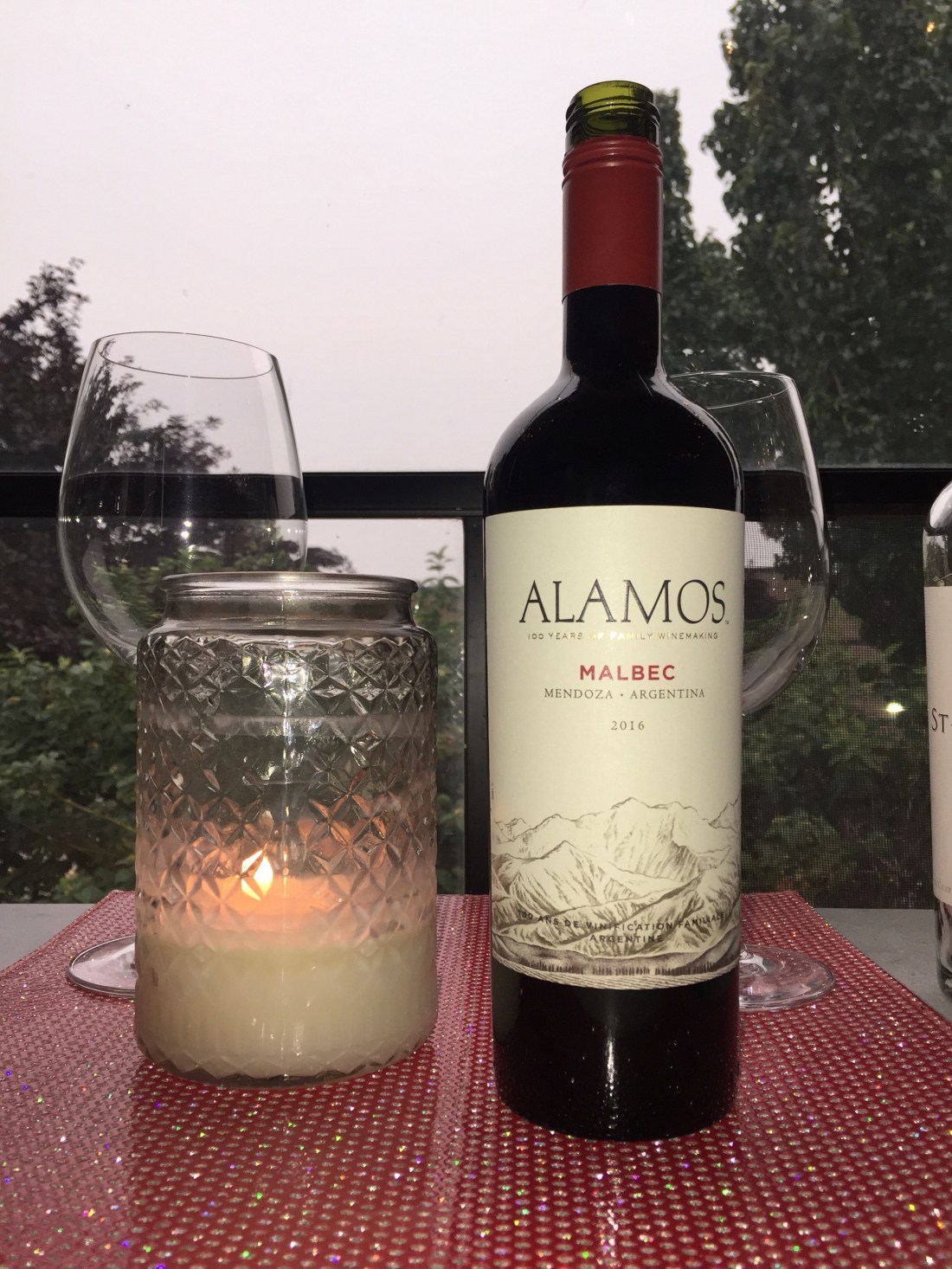
“When looking for value be sure to look at South America. Chilean Pinot Noir and Argentinan Cab Sav’s and Malbec’s. You can find inexpensive quality wines.” – Aaron

Great tips! They also include a category that I often don’t shop in because I don’t digest it well; however it’s widely liked, extremely popular and important to mention here – Sparkling Wine.

“One of my favourite tips for value is bubbly wines! I love my Champagne but don’t always love the price. Cava, which is from Spain, is made in the same style as Champagne but without the price tag. You can find lovely Cava under $25.” – Ivy


We met Sandra and Ian while they worked in the higher-ups of a restaurant we frequented.  Over wine, we discovered we had more in common than we realized, and became friends.  They’ve got ISG and WSET certificates between them, and Sandra has years of experience in high end service. Ian is the bar manager, and wine/spirits buyer, at one of our city’s most trendy, award winning restaurants, recognized as a top restaurant in Canada.  (He also designs hundreds of spectacular, award winning cocktails!)

Ian walked us through how he designs wine lists for his restaurants. His goal is to find wines that will pair with the menu, cover main regions and the grape varietals they do well, and be of value to sell to patrons, for example, Pinot Noir from Oregon, or Argentinian Malbec.

He also frequents industry wine tasting events and tries new bottles that reps bring to him on the regular, so he shows the value in trying new wines and producers.

He spoke highly of South African wines for value, while still being interesting to the palate, (look for KWV on the label for higher labour standards in South Africa), as well as one other particularly interesting grape, and left me with this hilarious, but true quote.

“Look for a good Petit Syrah; you’re going to enjoy the shiz out of that!” – Ian

Sandra’s value go to is the Santos de Casa Reserva Alentejano, retailing for $27.  They’ve shared this with us before – delicious.

“I love a well paired bottle of wine, but sometimes you get home from work and you just need to unwind and have a glass of something and you don’t want to plan your meal or think too hard.  This is the perfect go to for those occasions.  It is smooth and neither too dry or too sweet and will appeal to the seasoned wine drinker and the person just getting into wine alike.”  – Sandra


Ken

We were privileged to take our WSET Level 2 from this knowledgeable and intelligent man, who is well certified himself, and always continuing his wine education.  He is currently researching and presenting on Biodynamic Wines in his free time, and is a University Professor by day.  When I asked him for some tips for you, my readers, he shared some extremely valid points.

“It’s hard to say what a ‘good wine’ is for someone, so the answer for me is to drink more, and try everything!” – Ken

 That is very well said.  The wines my friends and I are presenting to you in this article are great to us, but may not be great for you.  These are meant to be a starting point in your exploring.  I must also note, that a ‘good wine’ to me 10 years ago, is not a ‘good wine’ to me now, because I’ve done more learning and exploring; tastes change, so try to hold an open mind and be discovery oriented.  Don’t they say we should enjoy the journey, as well as the destination?

“One approach is to look for lesser known regions that are close to the ‘famous’ regions, for example, rather than Chateauneuf-du-Pape, try something from Gigondas, which is close, similar, lesser known, and provides a good value.

Another approach is to look for ‘lesser’ sub-appellations within regions, so for example, if a person likes Chablis, Petit Chablis, rather than Premier Cru Chablis.  This doesn’t necessarily mean poorer quality, just different aging.  The longer it’s aged, the more money the producer has tied up in it, the more they need to charge for the wine.” – Ken

He does realize that some of his suggestions require some background knowledge, but encourages readers to have fun exploring and experimenting.  Plus, if you’re reading this, and have a more specific question about either of Ken’s approaches, you can leave a comment and I can help direct you.


Dawn

Dawn is certified in ISG and WSET Level 3, and runs the Tasting Room at our Coop Liquor. She is hilarious, kind, hospitable, a great chef, and extremely experienced and knowledgeable. That’s why the owners of Coop have put her in charge of choosing and buying every single bottle of wine that comes into that store! She works with wine producers all over the world, and here are her go to’s.

1.   “Bodegas Laya from Spain . It’s a big, full bodied red that over delivers for the price.

2.   La Vieille Ferme Rosé from France.  It is not as dry as some of the rosés from Provence, but it is very well made and always quaffable.  It is perfect on a summer patio day.” – Dawn


Our Tips to Affordable, Yet Still Great Wine

 1. Find an affordable producer that you like.  Chances are, if you really enjoyed one particular wine of theirs, you might also enjoy their other wines.

2. Shop lesser known varietals. You can find amazing value wine if you’re willing to step outside the Cab Sauv and Chardonnay boxes.

3. Avoid the mass production wines!  These are the ultra-cheap, big name companies, that I won’t name, but you’ve heard of them.  If they’re mass produced, they’re going to be a value, yes, but also boring and predictably not great. Look on the label for hints that they’re mass produced, like the non-specific region of “California,” for example, rather than “Monterey County.”

4. Shop in the European sections.  Many of the most overpriced wines come from the USA.  Canadian producers have high operating costs and small production, so they have to charge more.  You can get really great wine, for under $20 from Europe.  Our faves are almost anything from Italy or France, Riesling from Germany, Duoro from Portugal, Rioja from Spain.  In the Italy section, if they have a ribbon around the neck that’s a blue/gray and says DOCG or DOC on it, you know you’re getting a quality controlled wine, and yes, they have these for under $20.

5. Shop in the South American sections!  Carmenere from Chile and Malbec from Argentina, are great.  It’s also worth trying the whites from these regions. Last week we had an Eco Chilean Chardonnay that was superb, and $13.

6. Be willing to take a risk!  We had a Boutari from Greece last month that was $18.  We were in Greece in 2015, and no wine grabbed us as “the best wine ever,” but we decided to give the Boutari a go (open-mind!).  It was wonderfully crisp, with lemon and fresh herb notes to it that reminded me of being in Greece.  You don’t know if you don’t try.

7. Keep a list of what you’ve tried, and write down what you like or don’t like.  Have your “go to’s” for value white, red, sparkling or rose. I use the Vivino app to keep a running tally, and when I have time, I add my tasting notes.


A Sommeliers List – Available at the Coop Wine Spirits Beer store in Blairemore

Angela is the sommelier at the Coop Liquor Store and Tasting Room, she is certified in WSET Level 3, and is currently taking her two year Level 4 Diploma.  She sent me a list of her favourite value wines, all available at our Coop Liquor Store!  Upon getting to know her, I’ve discovered she’s passionate about interesting wines and discovering new, quality wines for herself and her customers.  She’s not going to set you up with something run of the mill or boring, which I really appreciate about her, especially because she fills my wine locker every month!  I’ve personally had all of the Under $15 wines, and they’re fabulous.  I would also mention that any wine by La Vieille Ferme I’ve had has been affordable and tasty.  Check out her list below.  What do you notice about it?

Under $15

• Plantaze Vranac $13.99

• Claude Val Rouge and Rosé $12.99

• La Vieille Ferme Red $13.99

Under $20

• Gerard Bertrand Corbieres $17.99

• Henry of Pelham Baco Noir $15.49

• Glenelly Glass Collection Chardonnay $18.99

• Mediterra Poggio Al Tesoro $19.99

Under $25ish

• Ricossa Barbaresco $22.99

• Gray Monk White Brut Odyssey $25.99

• Chateau Pesquie Les Terraces $22.99

There may be a lot of grape varietals that you haven’t heard of before.  Just because they’re not mainstream doesn’t mean they’re not flavourful, or a good value.  A lot of them are also international.  Hmm… I think I read that somewhere.

Remember, take a risk.  You might not like all of these wines, but you might also love them.  Now get to the store, find a value wine, and start popping corks, (or unscrewing screwcaps)!

A special thanks to all of my guests: Ivy, Aaron, Sandra, Ian, Ken, Dawn and Angela.  You’re all wonderful for taking the time to contribute and I appreciate you!

Cheers!