Three Amazing Must-Do Travel Bike Tours

We love traveling, seeing the sights, and being active, so it’s no wonder we’ve chosen to do bike tours on several of our trips. I also appreciate efficiency, and getting some wheels can greatly increase the amount of ground that can be covered in a short amount of time! We’ve biked in many places of the world, but these three experiences are all somewhat or fully guided, have given us the best bang for our buck, have offered very scenic exercise opportunities, and have provided amazing memories that we will cherish for life.

The Paris Night Bike Tour – 4 hours

http://www.fattiretours.com offers it for $69.95 and I recommend booking well in advance or it will be sold out! It’s got a 5 star rating on their site and I’m not surprised, as it is absolutely fantastic.

This tour was recommended to me by a friend before I had been to Paris for the first time, as it’s a great way to get some bearings on the layout of some popular tourist spots, and some general information. I recommend doing the tour close to the beginning of your trip for that reason. We did it, loved it, and have recommended it ever since. My sister and her friends booked it on my recommendation and highly enjoyed it as well.

We arrived on time, just after supper, at the address given to us upon booking, where we met our tour guide. We were set up with bikes and safety vests that were adjusted to fit us properly, and then we were taught how to use the bike. Paris is a very busy city, and we were going to be driving on the roads, with the traffic, so our tour guide taught us how to drive as safely as possible and how to keep up with the group.

Disclaimer: If you have never ridden a bike before, I wouldn’t recommend a bike tour in any large city as the place to learn. You don’t need to be an avid biker, but you do need to have some pre-established comfort on a bike.
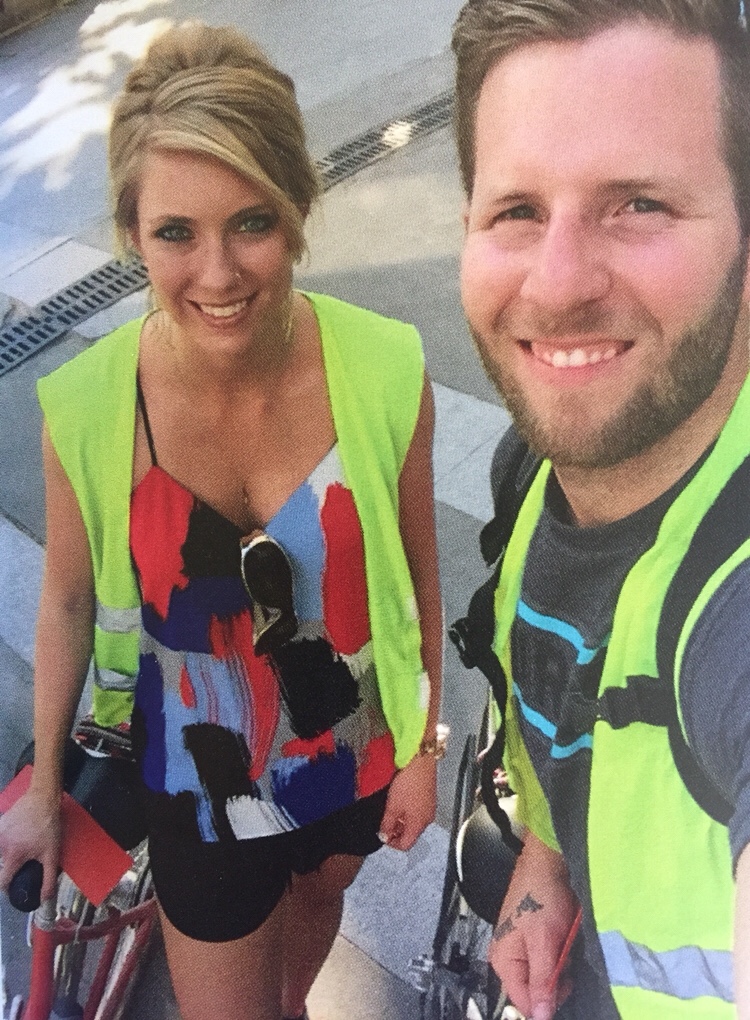
Once we were ready to go, we set off into the evening! We biked at a relatively quick pace, and stopped every so often to view a monument, take some pictures, and learn a bit about what we were seeing. We stopped at places like Notre Dame Cathedral, the Louvre, the Latin Quarter, and we even stopped for an ice cream at Berthillon, a place they claim is most famous in Paris.

Then we made our way to the river, where we locked up our bikes, and jumped on a boat for a Seine River Cruise. The river cruise is one of my absolute favourite things to do in Paris, as you can see so many of the city’s famous places from the water, sail under its intricately ornate bridges, and admire all the locals that gather to relax and socialize along the riverbank. The timing of the boat ride was perfect for us to see the sunset, and the Eiffel Tower sparkle in the dusk from the water.
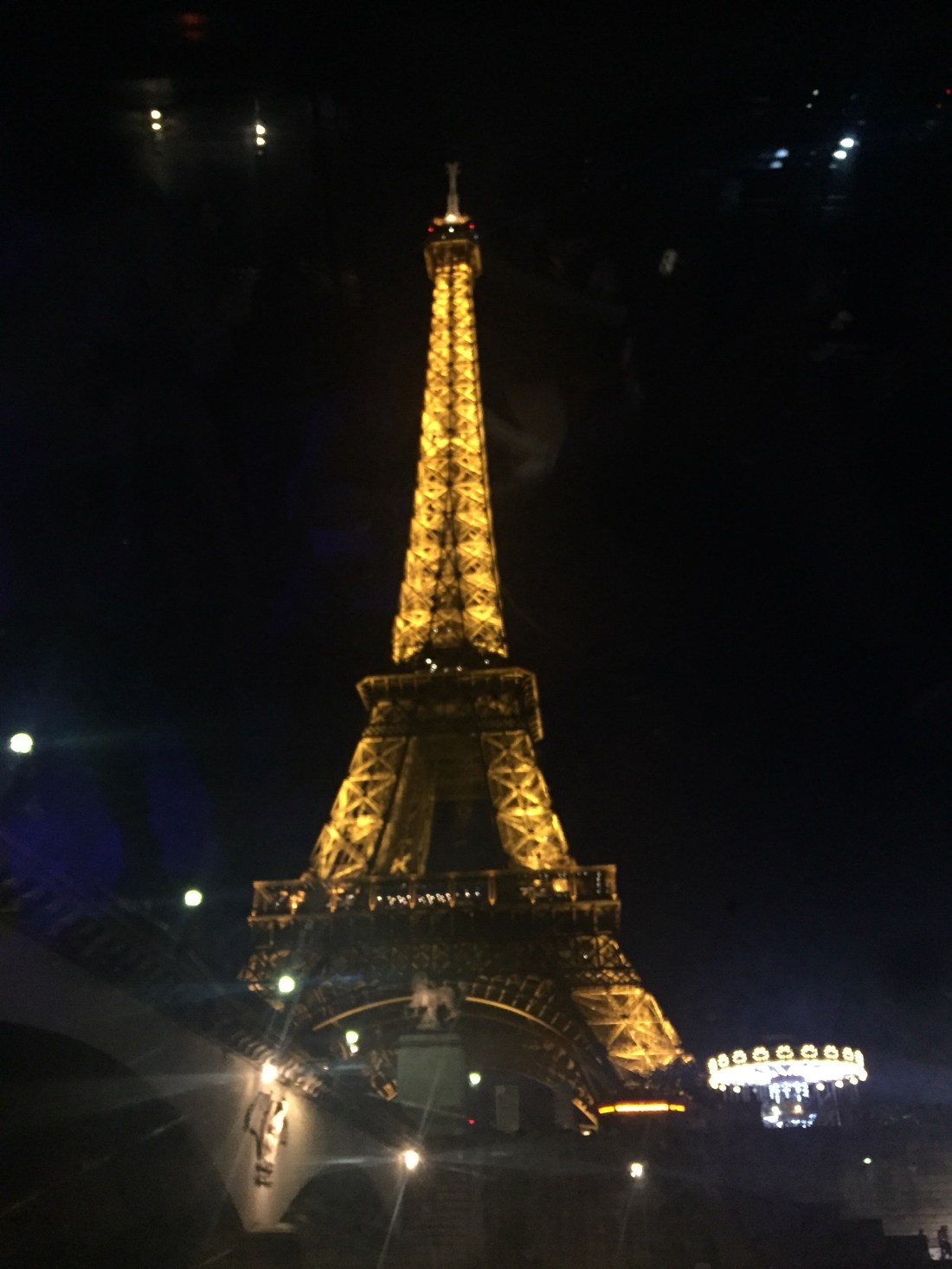
Oh, and did I mention the bike tour guide gives you free wine on the boat ride? Yes. Free wine. As much as you want. 🍷✔️

Once we got off the boat, we resumed our biking, perhaps a little wobblier than before the free wine, and made one more stop to see the Eiffel Tower again before heading back to the Fat Tire shop.

What a fantastic use of 4 hours in Paris!


Brooklyn Bridge Bike Tour
in New York – 2 hours

http://www.centralparksightseeing.com offers this tour for about $45, depending on what time and day you’re going.

Nobody had recommended this to me, but I wanted to do a bike tour in NYC, for the same reasons as on other trips: we cover ground so quickly, we get to meet other people, and we get some information about what we’re seeing, all while being active!

We were almost late for this one as we got lost on the Subway (so leave earlier than you think you need to), but we got there just before our group left. They quickly fitted us with bikes and we were on our way with our tour guide.

We biked at a reasonable pace, but we also stopped quite frequently on this tour to learn for a couple of minutes about what we were seeing. We rode through several old neighbourhoods that were the beginnings of Manhattan, down by the harbour, through the south end of Broadway, and China Town, while learning about some of NYC’s history. We pedalled across the Brooklyn bridge, breaking for some photos on the top!

Then we explored Brooklyn Heights and learned about the bridge and the area, before heading to the water’s edge near Jane’s Carousel to get a fantastic view of Manhattan, the bridge, and of course, some photos.

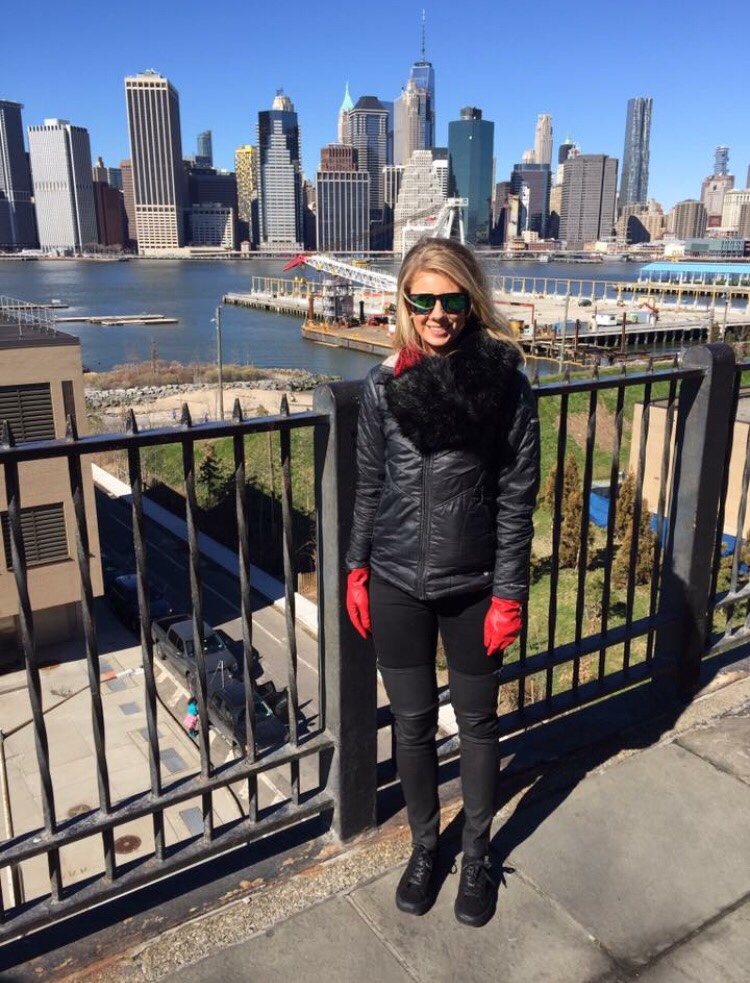
We made our way back across the Manhattan Bridge before ending the tour back at the shop.

This was an affordable and very informative tour with a friendly, personable and knowledgeable tour guide (ours happened to also be a college professor who was passionate about his city’s history), that left us feeling like we learned and saw so much that we just couldn’t have on our own.

They offer many different bike tours other than this one, so if you’re interested in other areas of the city, or want to do more than one tour, you could learn and see a lot!


Biking the Vineyard Trails of Burgundy
in France – full day

We booked rental bikes ahead of time through http://www.burgundy-by-bike.com for the very reasonable price of €20/day.

My heart smiles when I remember this day. It was easily not only one of the best biking experiences, but the best travel experiences – I’ll even say best life experiences – I’ve ever had.

We had watched some YouTube videos and read a few articles in our preparation to visit Burgundy (Bourgogne in French) and we’d seen a few recommendations to do the bike trails through the vineyards. As we love wine, we were going for wine, and we enjoy biking, we knew this was an absolute must for us.

There are a few companies that do guided tours, but we chose to rent our bikes in the town of Beaune, follow the maps they gave us of the bike trails and winery stops, and go independently of a guide. We didn’t know how long we’d want to be out, but we didn’t want to be limited by a group for this one, and I’m glad we weren’t, because we took the whole day!

We were fitted to our bikes, and given great directions and a map to get us through Beaune, and onto the bike path. Our map also explained exactly how many kilometres apart each of the towns were, so we could decide if we wanted to go the full distance or not.
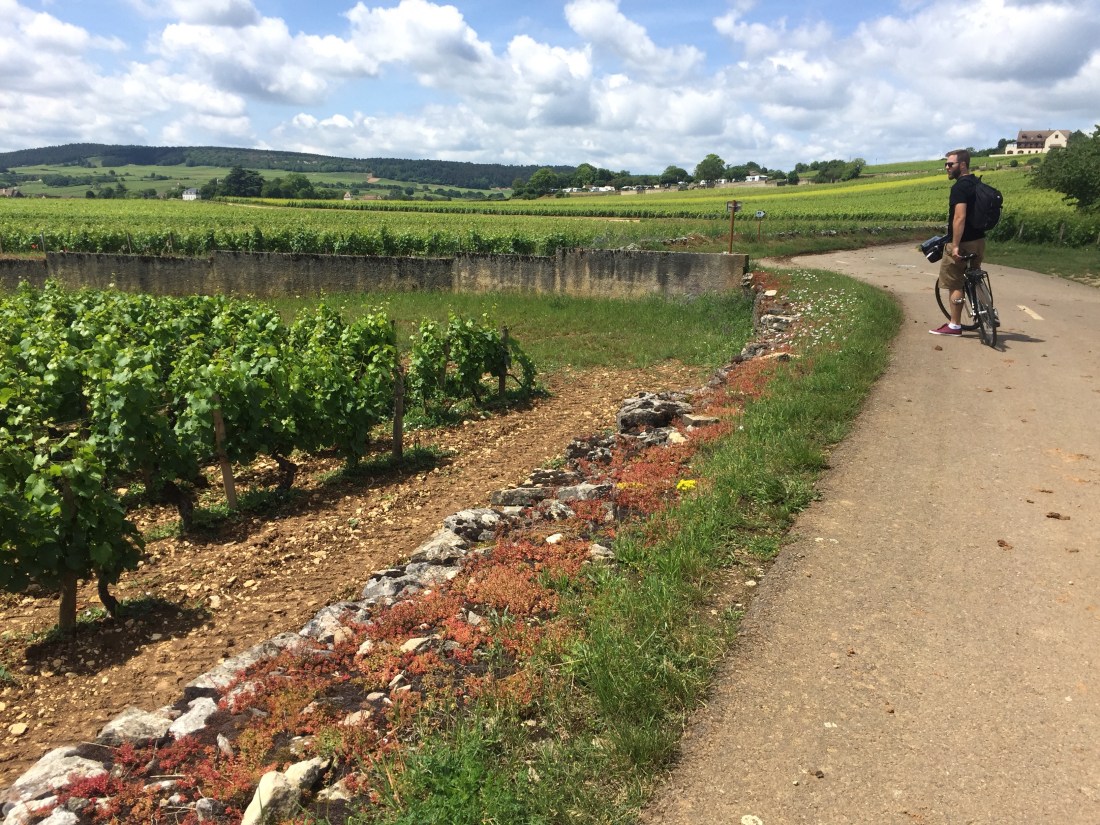
We had the most beautiful, magical day. This was my Disneyland! Biking through the vineyards of Burgundy is just breathtaking! For one, the views are stunning, and the history is ancient; these vineyards and wineries have survived wars, and the stories of the families are generations long. Secondly, Burgundy is not flat! Our breath was taken away many times on this hilly ride! We were there in June, and it happened to be a very hot, sunny day. There is little shade on the ride, so make sure you bring lots of water. There are a few towns that you can purchase food and water in along the ride as well.

We started off at the famous entry to the vineyards.

We rode through several towns in the morning, stopping at a small Chateau in Pommard for a wine tasting in their below ground cave.
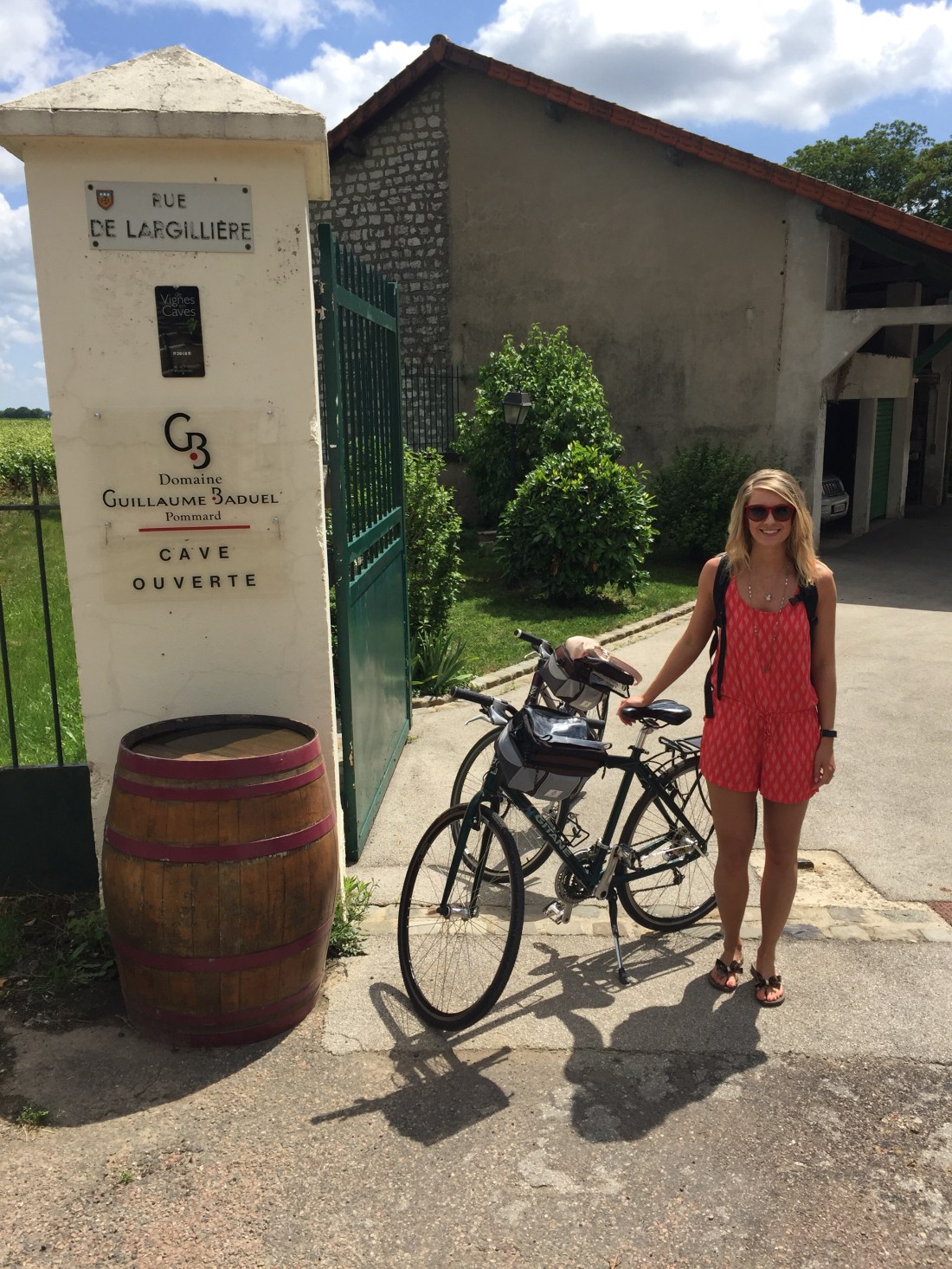
It was stunning, but the details of this are for another article!

We then rode through the villages of Volnay, Monthelle, and into Mersault, where we bought some beer and water and had a picnic lunch in the town square. It was scenic and quaint, with the church tower chiming away noon, and the small shop keepers closing up to enjoy the lunch hour by the trickling fountain. The town was alive with locals on their daily routes, and other bikers like us, stopping to enjoy the moment and some rest in the shade.

Once we were finished our storybook perfect lunch, we headed on towards Puligny-Montrachet, where we did another wine tasting. We then biked to Chassagne-Montrachet and finally Santenay, before deciding to turn around. We enjoyed little stops along the way to look closer at the vineyards and take photos, as well as to observe the village homes and businesses.

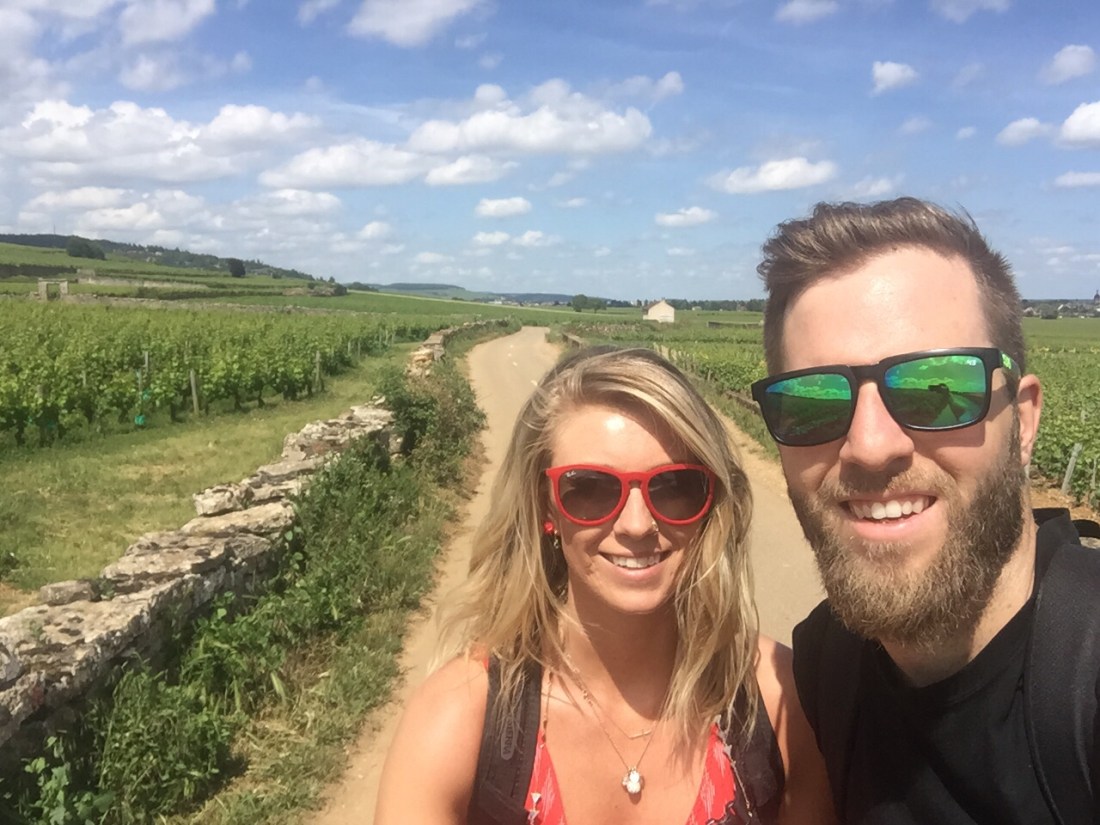
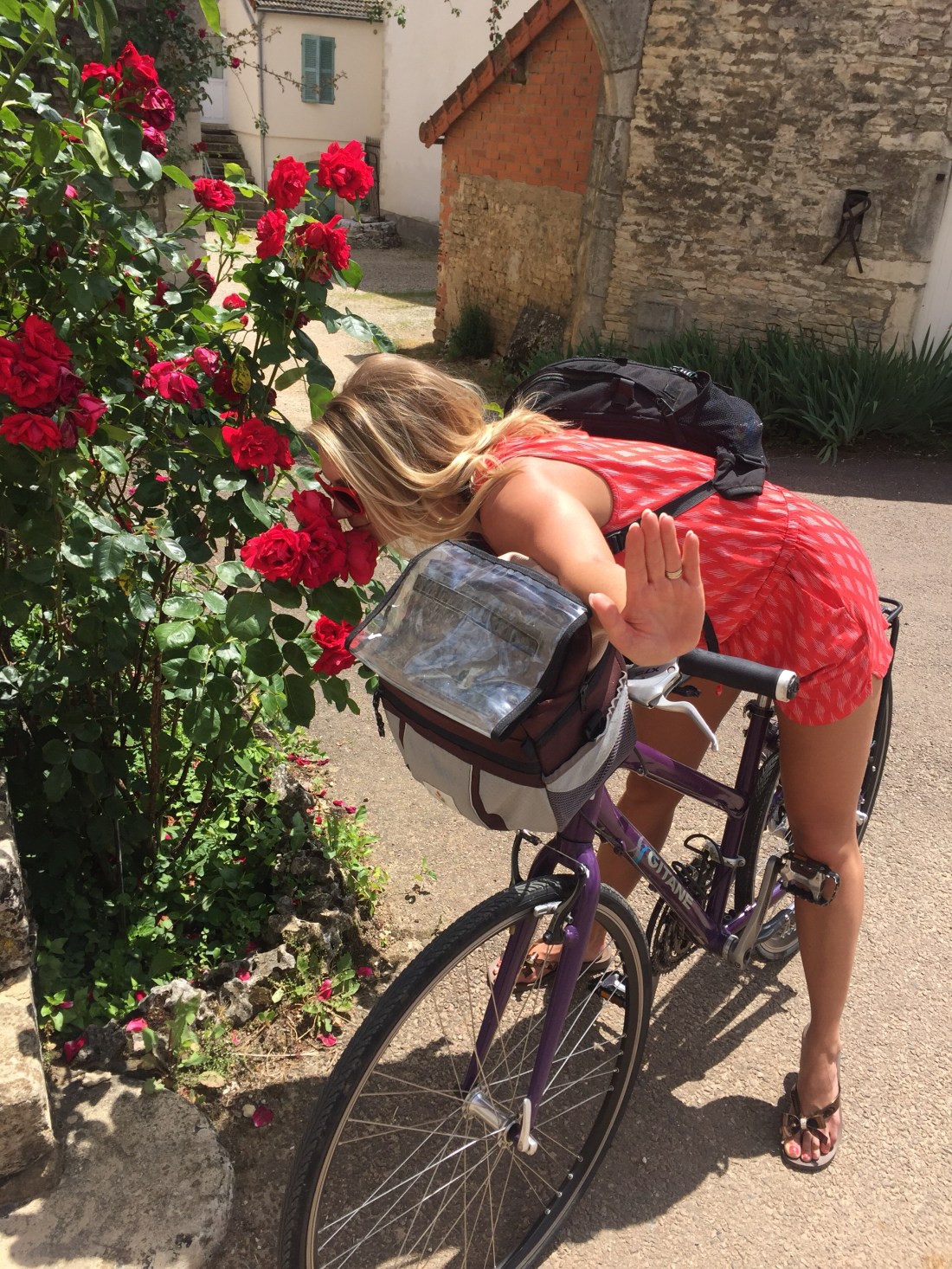
We also made sure to stop and smell the roses!
Biking in Burgundy felt so picturesque, so peaceful and so surreal that I had to keep reminding myself that I was really there, and it was really happening! I soaked up every minute of the experience and it couldn’t have been more perfect.

We put on 40kms on the bikes that day, so we were pretty tired by the evening, and it was so worth it!

So there you have it; these are my top three biking memories. If you are ever in any of those places, I highly encourage you to take advantage of the opportunities, and all they can offer you!

Happy travels!
Aging Wine; The Need To Knows

“You get better with age like a fine wine…” ❤️

We’ve all heard sayings like this before that leave us to believe that all fine wine gets better with age.  This is partly true – many fine wines do get better with some age – but which wines are meant for aging and how long they should be aged, is actually quite a complex topic.  Then there are multiple factors that come into play regarding storage/cellar conditions that will either age wine well, or ruin it quickly.

A huge misconception I’ve come across in speaking with friends and family about wine is that it ALL gets better with age.  This is definitely not true!  There is a saying in the wine world that only 1% of wine is actually meant to be aged in the bottle, which means that 99% of the wine on the shelves right now is meant to be consumed within a few short years from now, or today!  More on specific aging times in a moment. I’ll tell you right now, that 1% more than likely didn’t cost less than $20 either, so if you’re hanging on to those $7.99 bottles, it’s time to grab some glasses, or possibly make dinner with some type of a wine sauce!

Wine needs to have certain qualities to give it the ability to age well.  Madeline Puckette, the creator of Wine Folly, gives 4 qualities that you can look for in a wine to determine if it is age worthy:  Acidity, Tannins, Alcohol Level, and Residual Sugar.  [1]

Acidity

The higher the acid in the wine, the better it will age.  When tasting wine, acidity is the factor that makes your mouth water.  It is often described as “crispness.”  Chablis, for example, has a high amount of acidity, and can age well, even though it’s made from white grapes. (Tip your chin down with the wine in your mouth and see how much spit forms. If there’s a lot, it’s higher in acid!)

Tannins

Lots of red grapes have high tannins and can be aged for several years.  Sometimes whites have tannins, but rarely.  Tannins are chemical compounds that come from the seeds, skins and stems of grapes.  When you taste them in wine, they’re not so much a flavour as a feeling.  (That dry feeling you get along your gums, like when you drink a way over-steeped tea, is the feeling of tannins!) In the process of making red wine, the grape juice sits with these parts of the grape, allowing the tannins to enter the wine.  Some can come from oak contact as well.  Certain grapes are more tannic than others, depending on their composition, and certain wines will be more tannic if they’re left to sit with the skins, etc. for longer periods of time.  These tannins can be bitter and harsh in young wines, but they help them age well because with time, the tannins “soften,” and become more “well-rounded.”  This basically means that instead of the wine tasting sharp and pungent in your mouth, it will taste more smooth and balanced; higher tannin wines need age to taste better.

Alcohol Level and Residual Sugar

Red wines with higher alcohol content, closer to the 14% mark, will typically age better than lower alcohol reds.  Whites have lower alcohol in them, but some grapes have particular compounds and sugar levels that will allow for a decent amount of residual, that is, left-over sugar, once the fermentation process is done.  These whites, like Rieslings, for example, have a balance of sugar and acid that enables them to age well.

So now that you’ve determined you’ve got a wine you’re going to hold on to, here are some things to think about before you put it away and forget about it.

Screwcap vs. Synthetic Cork vs. Real Cork  

The method of capping wines is still a largely debated topic in the wine industry.  Real cork, vs. synthetic cork, vs. screwcap – there are a lot of opinions out there on which is best and why.  For more information on this topic, check out my article Real Cork vs. Synthetic Cork and Screwcaps. For the purposes of this article, I’ll only comment related to wine’s age-ability and storage.

Australia and New Zealand initiated the use of screw caps, and still use them on many of their wines.  Other countries have started following suit.  A screw cap does not indicate poor quality wine, it’s simply a method that some producers believe is the best way to seal their wines.  Wines with screw caps don’t need to be laying down for storage, but they can be. Screw caps haven’t been tested for super long term aging, but some can last a decade or more.

Wine professionals have recommended to me, on more than one occasion, that synthetic cork should not be left in contact with the wine for long periods of time; they say it can leave a plastic type taste in the wine, and can also leave other synthesized compounds in the wine, that they don’t want to be consuming several years down the line.  Stand those synthetic cork wines up for any length of storage.  Fair enough. These are also only guaranteed for a few years at best.

Wine with a real cork must be stored lying down.  Cork is a natural compound, and it dries out over time.  By lying the wine on its side, the wine stays touching the bottom of the cork, and the moisture helps to keep the cork damp enough that it shouldn’t dry out.  This is important, because if the cork dries out, it shrivels up and shrinks, letting too much unwanted air into the bottle.  Over the years, the overdose of oxygen will ruin the wine, leaving it “oxidized” and undesirable. Natural cork has proven the test of time and has lasted sometimes for hundreds of years.

Cellar Conditions

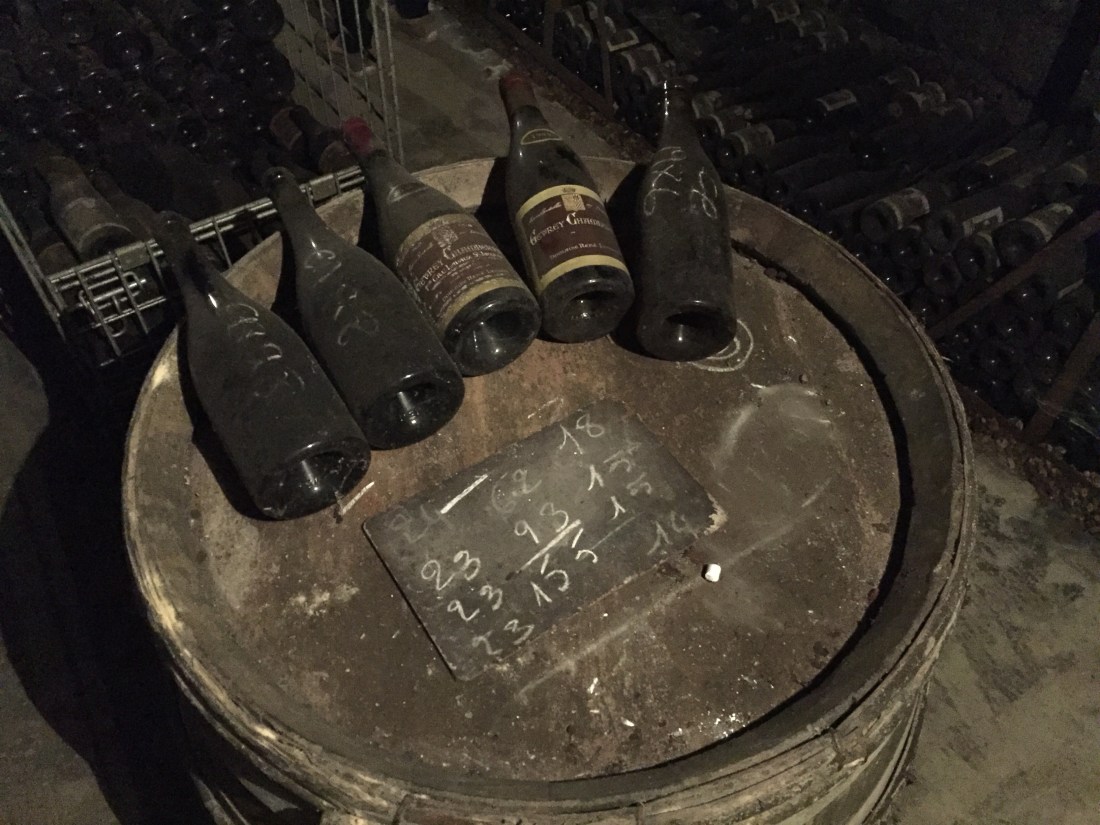
Have you ever been to a winery, or seen photos of their cellars?  What do you notice about them?  They’re usually cool, dark, and damp, and the wine is off to the side and out of the way so it doesn’t have to be moved.

Cellar conditions for ideal wine storage should be between 10 and 15 degrees Celsius, and shouldn’t change much.  Light shining onto the bottles for some time can alter the wine inside, whether it’s natural or artificial light.  Humidity will help keep the corks damp, so they stay plump and tightly sealed to the inside of the bottle’s neck.  The more you can leave the wine alone, without bumping it and moving it, the better its chances are of aging well.

When wine is resting well, it’s aging well, similar to you!  Just think of how well you would rest if someone kept changing the temperature on you, shining light on you, and bumping you around – exactly.  This is why I can’t sleep on an airplane. If you want your wine to be pleasant, give it a good rest!

Did you know that storing wine in a kitchen is actually one of the worst places in a home environment to keep it?  The temperature fluctuates the most in kitchens/bathrooms out of any of the rooms in your home.

How Long is Too Long?

There is a window of time that most wine professionals believe wine is at its best.  The window will vary slightly for each wine, but at a certain point, it will hit its peak, and begin to decline in quality again.  There is no exact way to know when this is, so it can feel like a risk when you’ve been aging a wine for a while, and want to make sure it’s at its best before popping that old cork ever so gently!

So many great wines become collector’s items, and people spend so much money on them, that they never want to drink them.  I once heard someone on a wine documentary say something to the effect of how many of the world’s greatest wines have essentially gone to waste, sitting in someone’s cellar for way too long, because people don’t understand how wine ages.  There’s a time and place for cellaring wine, but in the end, wine is meant to be drunk.

Jancis Robinson’s The Oxford Companion to Wine is one of my favourite wine books.  She says, “contrary to popular opinion, only a small subgroup of wines benefit from extended bottle aging.  The great bulk of wine sold today, red as well as white and pink, is designed to be drunk within a year, or at most two, of bottling.”[2]

In her expert opinion, she goes on to list specific numbers of years that several particular types of wine should be aged for, of which I’ve only included a few popular choices.  Almost all whites retailing under the $20 range should only be bottle aged to a maximum of 2 years.  Heavier whites, like Chardonnay can sometimes last up to 6 years.  More expensive whites can age longer, like Chablis (up to 15 years), or some Rieslings (up to 20).[3]  This has to do with the structure of the particular grapes, and how they’re produced.

Surprisingly, the number doesn’t differ much for reds.  If they’re around that same $20 mark or under, the longest Jancis recommends you keep them is 3 years.  You can hang onto higher priced French wines in your cellar from 15 to 25 years, Italian Chianti or Spanish Rioja can present nicely up to 10 and 20 respectively as well.  Above the $20 price point, most Cabernet Sauvignons can be bottle aged for 7 – 17 years, Pinot Noirs, 4 – 10, Shiraz, 4 – 12, and Grenache, 3 – 8. [4]  Jancis has not lead me astray yet, and I trust these numbers; keep in mind there are always exceptions, and your cellar conditions need to be appropriate, especially if you’re considering aging your own wines in the bottles.

*Note that keeping value wines up to that 2-3 year mark is NOT going to enhance their flavour; think of that time frame like a best before date.

To determine how long the wine has been in the bottle, you’re going to have to do some math!  The year on the label is the year the grapes were harvested, not the year it was bottled necessarily, so if the label explains that it was aged in the winery for a certain number of years, you can add that time to the year on the label to get the bottling year.

If you’re looking to age a wine, remember to look for wines that are balanced in acidity, alcohol, residual sugar, or have some tannin to them.  You’ll want to spend a bit more on these ones, and watch out for synthetic cork. If you’ve got a lot of $20 to $30 wines sitting in your house, it may be time to have a party!  Let’s not let that wine go to waste.  Happy aging of the appropriate ones, and cheers to all the rest of them!

[1] Puckette, Madeline.  (2017, Feb.)  “How to Tell If A Wine Is Age-Worthy.”  Retrieved from https://winefolly.com/tutorial/how-to-tell-if-a-wine-is-age-worthy/

[2] Robinson, Jancis.  The Oxford Companion to Wine.  2015.  Oxford, UK; Oxford University Press.

[3] Robinson, Jancis.  The Oxford Companion to Wine.  2015.  Oxford, UK; Oxford University Press.

[4] Robinson, Jancis.  The Oxford Companion to Wine.  2015.  Oxford, UK; Oxford University Press.

Red Wine Really Does Taste Better on Fruit Days 🍓 How I Put the Biodynamic Wine Calendar to the Test

I’ve heard it said that red wine tastes better on fruit days. First off, I can make my wine taste better? Second, what’s a fruit day? What does that even mean? Stay tuned and I’ll tell you all about it!

The biodynamic wine movement bases it’s entire operation on the lunar calendar. For vineyard practices, certain days are believed to be ideal days to water, prune, harvest, fertilize, etc. The lunar calendar doesn’t just determine when to do each vineyard practice; it’s believed that the lunar cycle affects us and our experiences of wine too. Biodynamic enthusiasts will tell you that wine will actually taste better on certain days than it does on others. This theory applies not only to biodynamic wine, but all wine. Crazy? Maybe. Maybe not!

Before you go discounting this whole idea, keep in mind that growing vines is essentially farming. The Farmer’s Almanac has used the lunar calendar for farming practices for decades, and if the moon can affect weather and climate patterns for other crops, it can certainly affect a wine crop, and potentially us!

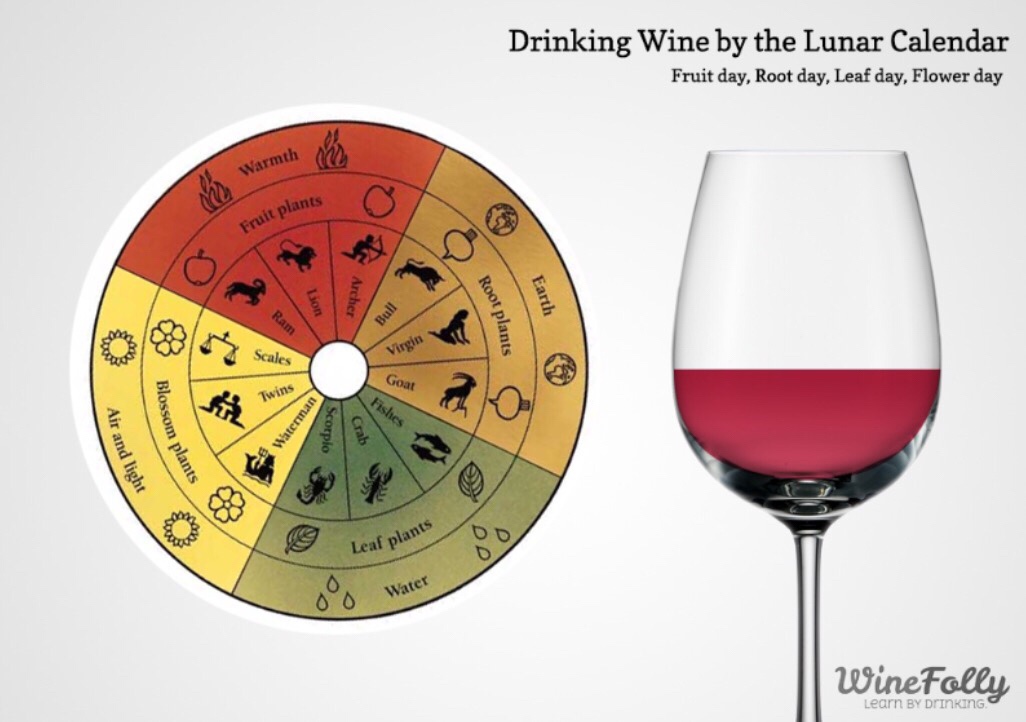
There are 4 types of days the calendar presents: fruit days, flower days, leaf days and root days. These days are determined by the lunar cycle, so sometimes an entire day will be one type, and sometimes the type will change part way through the day! For example, it could be a fruit day in the morning and change to a leaf day at 2:00pm if that’s how the moon cycle was at that time.

Okay, so you might ask how on earth (or should I say on the moon) are we supposed to know which day is which?

Thankfully there are lots of handy calendars online. Here’s a link to one I like: https://ca.rhythmofnature.net/biodynamic-calendar.

Alternatively, you can download a biodynamic calendar app (the only one in the App Store), but you have to pay in order to see ahead in the calendar, which with my planner personality, I don’t like.

Enough moon talk. Let’s get to the wine!

According to the wine tasting theory, red wine is supposed to taste best on fruit days, and white is pretty freaking great on flower days; awesome!

🍓 🌺

Apparently both red and white are supposed to be less enjoyable on leaf days and root days. Boo.

🍃 🥕

I’ve read articles written by people that have tested the theory and found it to be true, and others who think it’s a complete joke. I love a good experiment, and drinking wine, so naturally, I had to see for myself! My husband did the experiment with me, and we found that red wine actually did taste the best on a fruit day!

We took this experiment pretty seriously, so before you judge me as completely off my rocker, have an open mind and read on.

Here’s our experiment:

Hypothesis:

I figured we’d each agree on our enjoyment of the wine for no more than 2 of the days, and that we would not be able to peg the fruit day specifically. (I clearly had little faith in this theory!)

Materials:

  • A good friend to determine 4 blind tasting dates for us (as I couldn’t check for myself in order to keep them anonymous)
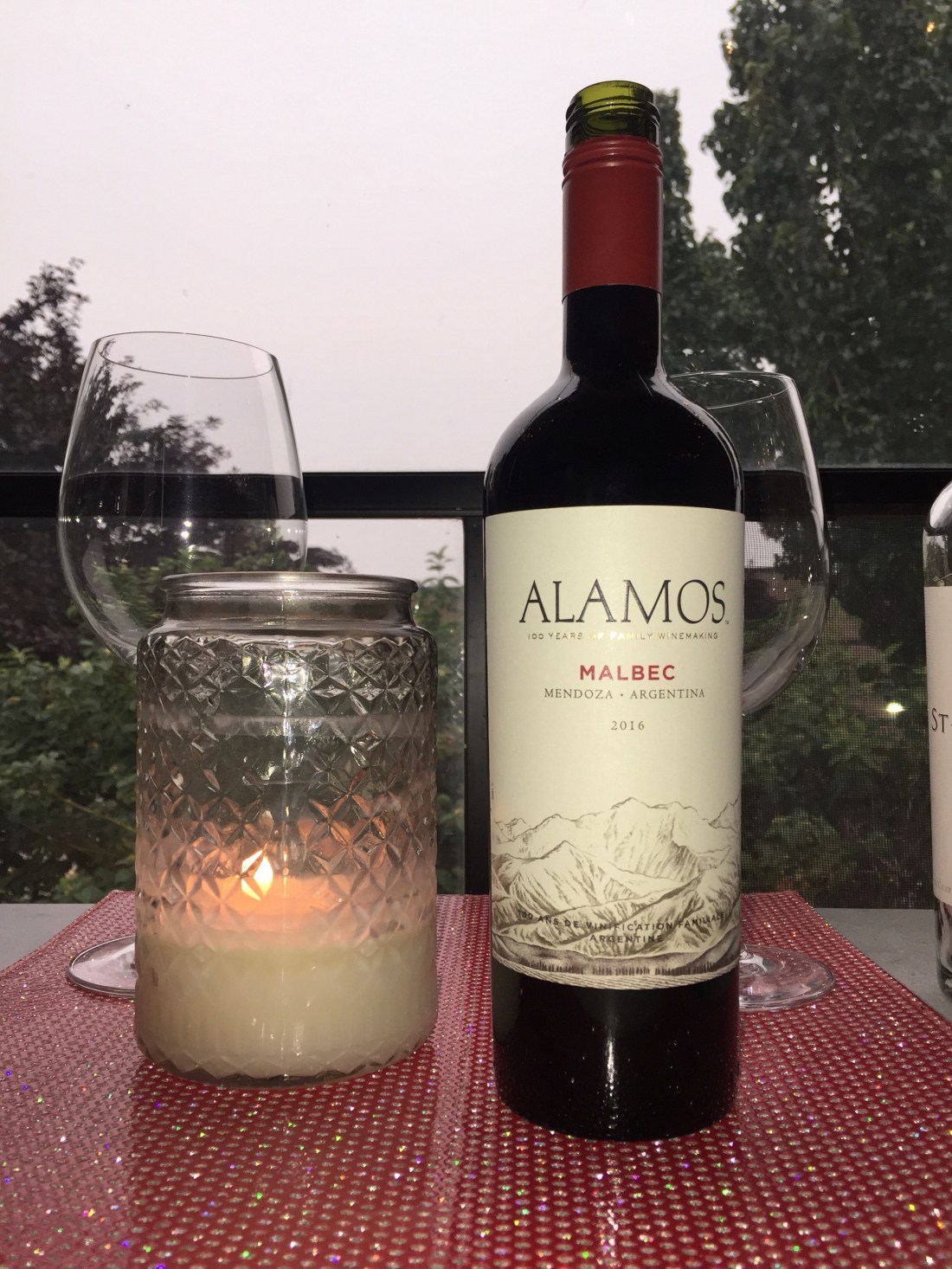
  • 4 bottles of red wine of the exact same producer, grape, and vintage (the control) 🍷 🍷 🍷 🍷
  • Wine glasses (cause drinking from the bottle’s just not classy)
  • Pen and paper (and an ability to keep secrets!) ✏️ 📝
  • Open minds (reader, you need this too!)

Procedures:

I wanted this to be as legit as possible. I had my friend, Ivy, check the biodynamic calendar and select 4 days during my upcoming holiday. She checked 2 calendars just to be sure, and gave me 4 dates that covered each kind of day, without telling me which was which. (Very secretive!)

I wanted to do the whole experiment on holiday so that I would be in roughly the same type of happy mood each day (which ended up slightly failing, as I’ll explain below).

We selected a type of wine that we don’t normally drink a tonne of, (yes, it was difficult, but we found one) and a producer that we had never tried before, so that we wouldn’t have many past experiences to compare the wine to.

We purchased 4 bottles of the same wine, so that each day we could open a fresh one. Have you ever tried week-old opened cheap red? Yikes! Don’t! This way there could be little risk of the taste having changed from oxidation over the course of the week.

We made sure to chill them each to the appropriate temperature range, and to drink the experiment wine first, before any other wine or food that evening (to ensure we were of perfect clarity of mind and palate).

We each kept notes of our level of enjoyment of the wine and gave it ratings based not on quality, but on how we felt it tasted (as that was the goal of the experiment).

We did not peek at the biodynamic calendar at any time. (No cheating!)

Lastly, we did not discuss the wine with each other at all until the whole experiment was done. No tasting notes were given, not even if we liked it or not, nor any guesses or comparisons – we said nothing, to keep it completely subjective. (As wine education lovers this took incredible self-control!)

(Image from winefolly.com)

Results:

Upon comparing our notes, we both felt the wine wasn’t that great on Day 1, which turned out to be the root day. My husband gave it the lowest score, and I gave it the second lowest score on this day. Interesting! 🥕

We were in between on our opinions on Days 2 and 3, which ended up being the flower and leaf days, however I must add that I gave it a high-ish score on Day 3, the leaf day, as I drank it in the first good sun tanning weather I’d had on the trip. I believe the perfect weather probably affected my emotional experience of it – I was really happy when I drank it! It wasn’t very complex that day, but it seemed enjoyable. This goes to show that environment and mood also affect enjoyment of wine. 🌺🍃

Finally, we both pegged the fruit day right on! 🍓

On Day 4, we had just had an afternoon nap, woke up before a dinner date, and it was raining, but we knew we had to taste the wine before we could go out! It shouldn’t have tasted good in that setting, but it was immediately, upon first sip, the best and most complex it had tasted to both of us during the entire experiment. This was mind blowing to me, because I was not expecting to actually notice that much of a difference! Once we looked up the days and realized it was the fruit day, we were both shocked that it was noticeably better for both of us on that day, without us knowing any better or speaking to each other about it.

🍓🍷✔️

This could be one factor to explain how sometimes a wine is so good, but when you open the same one the next time, it’s not as good as you remember, or vice versa.

Based on my results I’d absolutely recommend saving higher priced red wines to drink on fruit days, or at least when you’re in a fabulous mood!

Further Experimentations:

I want to try this with whites, and see if we can peg the flower day. 🌺

I also will choose dates for my friend, Ivy, and her husband to do their own version of the experiment to see what kind of results they get. 📝

If you think this is all complete BS, that’s fair. I honestly did too. Now, I’m open minded to it and will be paying closer attention! ✔️

I challenge you to try it for yourself. You might just be surprised! At the very least, you’ll have some bottles of wine with someone you like, and that’s pretty great in itself.

Happy fruit and flower days!

🍓🌺

How to Teach Phys-Ed in Heels

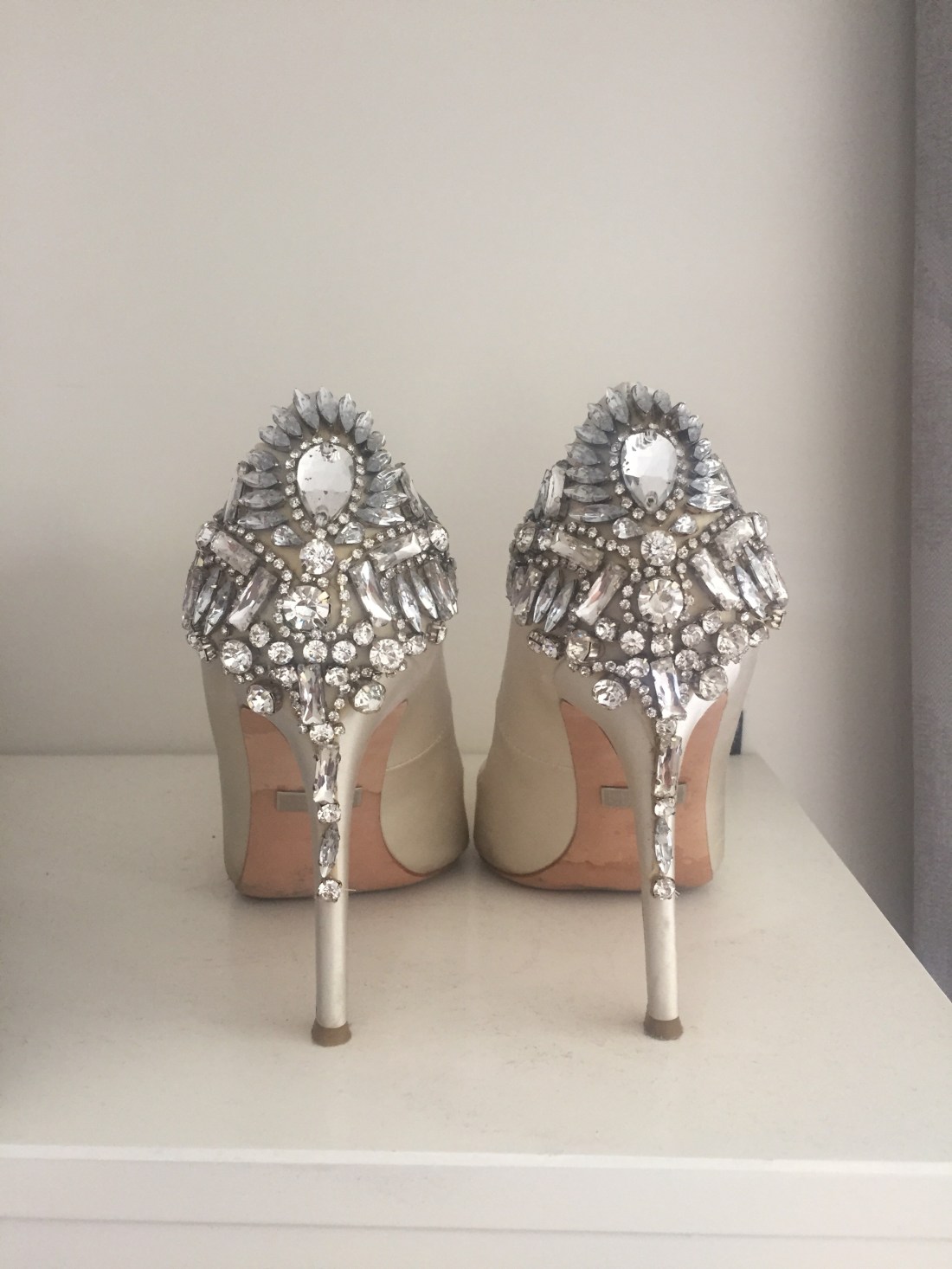
Anyone who knows me can tell you that I adore high heels.  I’m not prejudiced either; I love them in all shapes, colors and styles!  My clock is a red high heel.  I have a high heel shaped tape dispenser (thanks, sis), wine bottle stand, cake server, calendar… Even my spoon rest on the stove is a red high heel.  I also have a few real pairs… (okay, I’m being modest).  After my husband accepted the fact that he’ll never get me to stop buying them, he built me a closet for them.

I originally took my teaching degree to teach Middle Years students, but jobs are scarce in my small city, and if you want one, you take what you get and you don’t get upset!  Long story short, I ended up becoming an Elementary Phys-Ed Teacher for a couple of years.  That’s not where I thought I’d end up, but being the perfectionist that I am, I set out to do the absolute best job that I could, while still being myself, of course.

Myself – wears heels.  I was the gym teacher who wore heels every day.

My students quickly became fascinated with my shoes.  They would wait to see which pair I’d have on each day.  A rumour went around my school that I’d never worn the same pair twice, which I’ll assure you is not true!

“How many high heels do you have?” I’m often asked this question.  My students could tell you the answer I always give.  “I refuse to count.”  There are some things you just don’t need to put a number on.

Another frequent question I hear is, “how do you walk in those shoes?”  My answer to that one is, “the same way you do.  One foot in front of the other.”

“Those can’t be comfortable,” they say.  Honestly, they’re not always comfortable, no.  If what you value most in footwear is comfort, then heels are not the shoes for you.  If you value style, I would argue that there are stylish shoes in any heel height, right down to pretty flats and funky sneakers.  Wearing heels is important to me.  I feel good in them, even if my feet don’t always feel good.  (However, at work I am practical in my choices; I do have several comfortable pairs of heels, that I can wear all day, be active in, and my feet are fine at the end of the day.) Some women do a lot more difficult things in heels than teach! You get used to them.

It was inevitable that someone would eventually comment on my ability to teach phys-ed with heels on.  Some wondered how I could possibly do a good job if I wasn’t in runners.  It’s amazing to me some of the things that people decide to care so much about.  Is my shoe choice really that big of an issue that it needs to become a topic for gossip?

I kept a pair of runners at school for the days I needed to demonstrate a skill; I was the teacher – I knew when those days were coming! With my hobby job and certifications in the fitness industry, I also knew the importance of modeling proper footwear for my students when doing physical activity.  On the contrary, anyone who’s ever taught a phys-ed class knows that the teacher’s main role is not to get in there and participate in every sport.  It isn’t summer camp, and I’m not a counsellor; the teacher’s role is to educate, supervise, support, build relationships, and assess (plus so much more), much of which can be done in heels.  It can – I did it.

My boss thought I did a great job.  The kids thought I did a great job.  Any parent that actually spoke to their child in my class knew that I poured my heart and soul into being the best phys-ed teacher I could, while still being me.  One of my colleagues suggested I do a professional development at a conference titled, “How to Teach Phys-Ed in Heels.”  I didn’t get the chance, so I’m writing this in honour of her now. She knew I was fulfilling my professional duties, while still expressing my personal style. (Thanks, Heather!)

My heels can tell stories.  I remember where I was when I bought them, or an experience I had while I wore them.  I have shoes from places around the world, and when I look at them, they remind me of that trip, or that place, and that brings me joy.  My heels were a point of connection for my students to ask about my stories, and my life.  They were a discussion starter, and a symbol of me, to them.  Now, because of those cute, honest conversations with kids, some of my heels have become reminders of my students, to me. When I see certain pairs, I can see their beautiful little faces.

I’ve had parents tell me more than once that my name gets brought up when their kids see high heels on movies, shopping, or on trips. It warms my heart; it’s nice to know they think of me.

I asked my husband once if it’s dumb that I’m known throughout the school for my shoes. I said, “that’s a really trivial thing to be remembered for.” He reminded me that my shoes are just a fun part on the outside, and how any student that has actually worked with me will remember me for how I impacted their lives. Upon receiving their farewell cards this spring, I can see that they will remember me because I helped them learn something, overcome something, because I listened, because I showed them love. The heels are just a visual reminder.

Whether I want to admit it or not, wearing heels has become a part of who I am.  I feel like myself when I have them on.  People can think what they want about that. As educators, we teach kids the importance of ignoring negative criticism, and fully embracing their own little (or big) personalities. We try to instil values in them like independence, strong self-esteem and acceptance of diversity. We teach that doing things to help them feel great, beautiful, confident, or like they’re being true to themselves is important in presenting their beautifully and wonderfully created selves to the world around them.  Why should we not do the same?