Real Cork vs. Synthetic Cork and Screwcaps

Real Cork

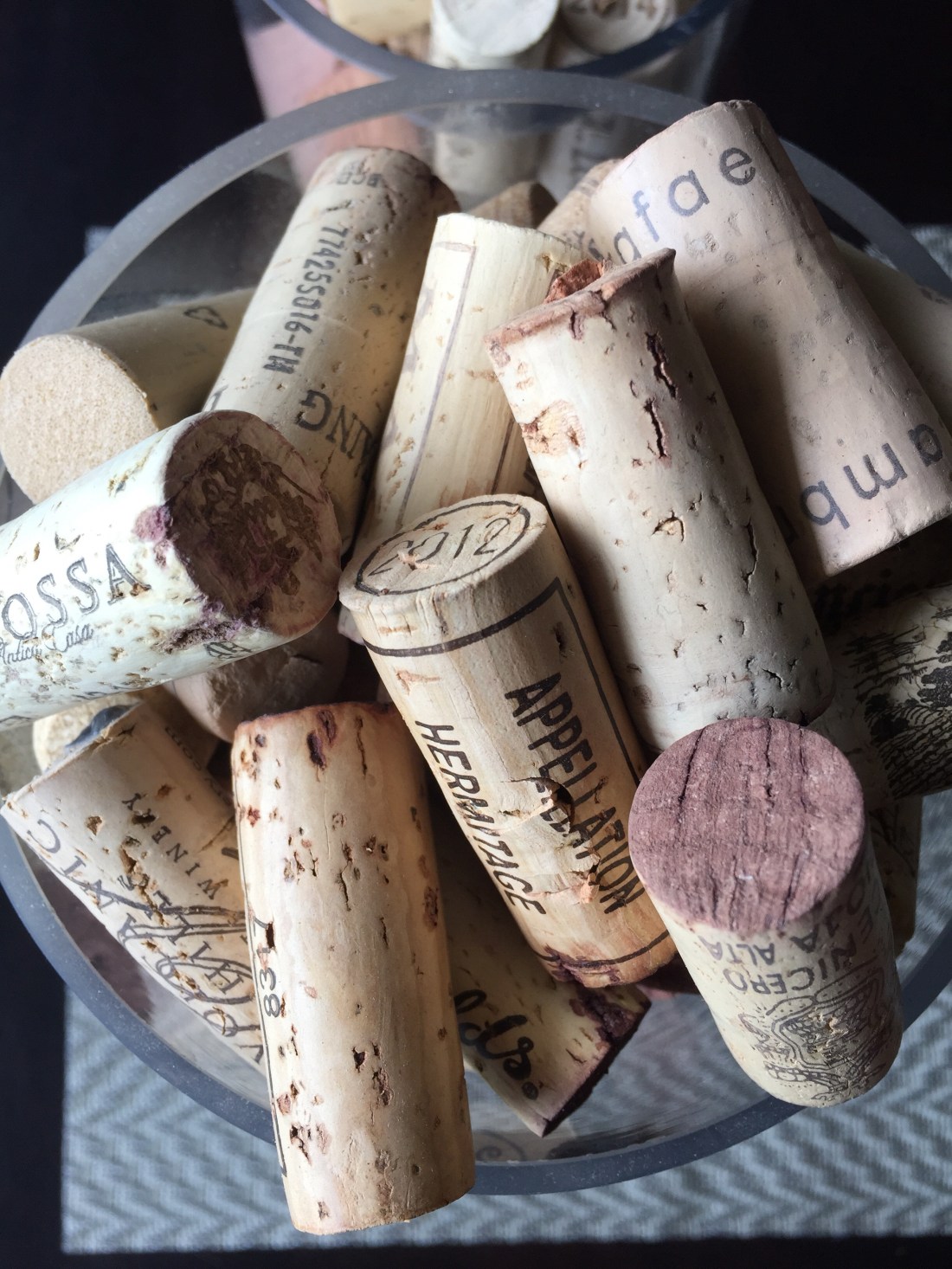
Cork is a natural substance that has been used for thousands of years by multiple ancient civilizations.  We now associate it mostly with wine stoppers, but I didn’t know how that usage came to be until I did some research.

“The most significant development occurred in the 1600s, when Dom Perignon, developed his methode champenoise.  The wooden stoppers used to store still wines had considerable disadvantages when applied to sparkling wine.  Dom Perignon successfully adopted cork stoppers and soon cork became essential for wine bottling.”[1]

Way to go, Dom!

Natural cork has its benefits.  We know that it has good results with long term aging.  It allows a very small amount of oxygen to slowly enter the bottle over the course of several years, helping harsher wines, with lots of tannins, to soften and become more easily palatable and interesting.  Too much oxygen will ruin a wine, and quick.  Think of it like The Three Bears scenario:  too much is bad, but too little is bad – it has to be just right.  It’s also a somewhat renewable natural resource.  “Cork continues to re-grow after the bark has been harvested.  However, it needs time, so the cork bark is only harvested once, every 9 years or so.”[2]

People also seem to love wine with real cork in it.  It feels more authentic and traditional, and hints at better quality.

I found results to a study done at Oxford University that supports this argument.  They found that wine tasted better to the participants if it had a cork, because they believed and expected it to be better, as opposed to a screwcap.  The study tested 140 people that tried two similar wines back to back, one with a cork, and one with a screwcap.  They then sampled the same wines again, without realizing it, except the tops were switched.  Each time, they were asked which one tasted better.  113 of those people chose the wine with the cork, each time, even though the wines had been switched on the second round.[3]

The Professor who performed the study explained that “our senses are intrinsically linked – what we hear, see and feel has a huge effect on what we taste.”[4]  This just goes to show that no matter the truth behind the wine closure, many people want a cork in their wine, because it enhances the experience.

I have to admit, upon first reaction, I like a real cork too, especially on an old bottle, when there’s a bit of fungus growing on top.  It reminds me that the bottle has a history, and a story, and it feels real.  I have to correct my reaction that seeing a synthetic or screwcap top on the bottle doesn’t imply the quality is less.  Real cork just plays into the fanciness, and the classy feeling that uncorking a wine gives.  It’s part of a ritual, if you will, when one wants to really enjoy a wine.

So if cork works, and people love it, why would anyone not use cork?

That’s where TCA steps in.  Dun dun dun…play the scary music.

TCA stands for Trichloroanisole, and basically, it’s a compound that forms in natural cork, and ends up getting transferred into wine, through that cork.  Terms such as “cork taint,” or a wine being “corked,” are referring to TCA.  If you’ve ever had the opportunity of smelling a wine that’s been affected with cork taint, it’s really bad!  The smell reminds me of an old church garage sale, or my grandmother’s basement storage room, that’s had a little bit of water in there over the years, hasn’t been dusted or cleaned out, and is probably growing mould.  As you can guess, it has a similar, unpleasant taste, too.

TCA’s not going to kill you, and as far as we know, it wouldn’t even make you sick – if you could still stomach the wine.  What’s likely to make you sick, however, is how your beautiful, expensive bottle of wine you’ve been anticipating is now effectively ruined.

You can find countless different statistics all over the internet on the percentages of wines that have been ruined by cork taint.  There was a big surge of it in the 1990s, that got people looking for other methods to close their wines.  On one of the wine tours we attended, the guide explained that they had switched to screw caps during that time, because they were finding that up to 10% of their wines were tainted.  Other statistics claim it was as low as 1-2%, and I’ve heard up to 20%.  There really isn’t an extremely accurate way of tracking this, and it differs from region to region.  A certain batch of cork could have been tainted, or it could have been a poor winery practice that caused the taint in the wine.

The numbers have significantly dropped now, as the cork industry got on top of the issue.  “Quality procedures have been overhauled, starting in the cork forests” with procedures to prevent the mould from getting into the cork itself.  The storage has been improved with “new factories close to the forests…the bark is stored only on concrete or stainless steel, never touching bare earth.”  The cork is also “rejected if [it shows] the slightest hint of a greenish stain,” and the bark is turned into corks by hand, “ensuring that the corks are taken from the best part of the bark.”  Nothing is wasted, and all the unused material is recycled.[5]  From the sites I referenced in this article, it seems to be that the percentages of cork taint have dropped significantly; the wine buyer at my favourite liquor store says that they hardly ever have returns anymore for this issue, and in all of the wines I’ve bought from them, and had in their tasting room, I’ve only ever seen one corked one.

Synthetic Cork

An alternative to real cork, is synthetic cork.  With this, there is no risk of TCA.  Synthetic cork can also be way more affordable for producers who are making inexpensive wines, meant for immediate consumption.  We don’t see super cheap wines in Canada very often, but if you’ve travelled Europe, you know that you can get some wines for less than $5.  Robert Joseph of Decanter makes an excellent point for why these types of producers may choose synthetic cork.  “When you are earning €3 a bottle, it makes no sense to spend a sixth of that sum on a top-quality cork.”[6]

It may be more consistent, and cheaper than real cork, but it’s also plastic, and not natural.  Jeff Leve explains that “the problems with synthetic corks is the lack of a perfect seal.  In turn that allows more unwanted air into the bottle, causing the wine to oxidize.  Worse, many of the synthetic corks have been known to impart a slight rubber or chemical smell, damaging the wine.” [7]  I’ve heard several of my wine industry friends complain of this happening; they say that if they’ve aged a wine on its side, and the synthetic cork is touching the wine, it can taste like plastic, so they always store their synthetically corked wines upright.  As for the lack of perfect seal, Jeff explains that some wine makers prefer this, if it can age their wines more quickly, to be consumed sooner.  He says there are also many companies now that are coming out with synthetic cork that lets in a more controlled amount of oxygen.[8]  There has also not been proof of how well it holds up for long term aging.

Screwcaps

The good old screwcap is another manufactured wine closure that is more cost effective, and less environmentally friendly, than real cork.  It also eliminates the risk for TCA, or plastic tasting wine; however, as you read above in the Oxford study, it’s associated with cheap wine.  Australia has put significant research into screwcap closures, as an article in the Sydney Morning Herald explains.

“The winemakers worked with the Australian Wine Research Institute, which over a 24 month period conducted trials that tested nine different closure methods (including natural cork, synthetic cork, technical cork and screwcaps.  After nine months under screwcap, each bottle of the same wine tasted the same… but the same wine under eight different cork closures all varied in taste.”[9]

I like some good research to back any fact, and I am impressed that there has been significant testing done on this issue.  Taylors Wines was the first winery to bottle every wine they make with a screwcap closure, in 2004, even though they risked what people’s opinions of the quality would be.  Now, 98% to 99% of Australian wines are bottled under screwcaps.[10]

Unfortunately, using a screwcap doesn’t guarantee a perfect seal.  There are some screwcaps that have been designed to allow slow amounts of oxygen into the wine, so that it can get some aging benefits, but it’s very possible that when the cap is getting attached to the bottle, it might not seal correctly.    I’ve had this happen to me before, (once) and had to send wine back to a winery because of it.  A wine expert taught me a good way to test this; when you’re buying a screwcap bottle, gently try and twist the closure under the lid, to see if it will rotate around the neck.  If it’s stuck to the neck and doesn’t rotate, you’re good.  If it does rotate, the bottle has not been sealed properly, and you could find that it’s been oxidized.

New Zealand launched their initiative to use screwcaps on even their top quality wines in 2001.  The initiative aims to “encourage and facilitate the use of screwcap wine seals by New Zealand wineries,”[11] and basically also to research them and make them super awesome! Excellent! You go, New Zealand! Maybe they’ll find a solution to ensure even more bottles are sealed tightly.  They do believe that screwcaps can be guaranteed to age well for considerable time, which is another plus for them; I’ve heard up to 10 years or more.  The founders of the initiative believe that cork taint is a considerable problem, and should no longer be tolerated, and seeks to find new and better ways.

It seems to me that our opinions of quality, based on a judgement we make on seeing the wine’s closure, may be preventing us from enjoying actual quality in some wines.

Didn’t anyone tell us not to judge a book by its cover?  In my opinion, those who judge all wines by their screwcap ‘cover,’ are missing out on some of the best wine ‘stories’ out there.  For example, I continue to buy Australian wine, even though it’s closed with a screwcap, because one of my favourite wines of all time is Penfolds – screwcap tops, amazing quality.

Let’s not be so hasty in our judgements anymore, wine drinkers!  Have you had a poor quality wine with a screwcap?  Yeah.  Have you had a poor quality wine with a synthetic cork?  Yes.  How about with real, natural cork in it?  Uh huh – me too.  I’ve also had great bottles with all three closures.  There’s so much more to what’s in the bottle, than what’s on top of the bottle.

There are no guarantees that every single bottle coming out of production is going to be perfect when it’s opened, no matter the type of seal.  There is always that small risk that it’s going to be corked, or oxidized.  That’s why in a restaurant, when you order a bottle, they allow you to taste it before it’s served; you’re checking that the quality is acceptable.  Luckily, most wine stores and producers understand that a percentage of damaged wine is part of the process, and I’ve never had anyone refuse to refund or replace my corked or oxidized bottles.

In the end, wine producers need to weigh their options and determine what’s going to suit them best.  As a buyer, knowledge is power.  It’s good to be aware of the pros and cons of each wine closure, and to eliminate misconceptions as much as possible.  When you’re purchasing a wine, and you’re looking at the closure, think about what that wine’s purpose is going to be for you.  Keep an open mind.  Who knows, maybe in a few decades, the sound of a screwcap seal breaking will have a friendlier association… we can hope!

Happy wine-ing!

Special thanks to Chad for asking me to write this article, which required the most research I’ve done since being in University… I guess we do learn to cite things for an applicable life reason. 😉

[1] Unknown.  “History of Cork Usage.”  http://www.corkqc.com/pages/history-of-cork-usage.

[2] Leve, Jeff.  “Wine Corks Everything You Need to Know About Wine Corks.”  https://www.thewinecellarinsider.com/wine-topics/wine-education-articles/wine-corks-everything-need-know-wine-corks/.

[3] Yorke, Harry.  “The Great Wine Debate; Corks really are better than screw-tops, Oxford study finds.” http://www.telegraph.co.uk/news/2017/09/27/great-wine-debate-corks-really-better-screw-tops-oxford-study/.  (September, 2017).

[4] Yorke, Harry.  “The Great Wine Debate; Corks really are better than screw-tops, Oxford study finds.”

[5] Bird, David.  “How the Cork Industry is Fighting Back.”  https://www.decanter.com/features/which-cork-is-best-246798/

[6] Joseph, Robert.  “Which Cork Is Best?”  https://www.decanter.com/features/which-cork-is-best-246798/ (January, 2009).

[7] Leve, Jeff.  “Wine Corks Everything You Need to Know About Wine Corks.” https://www.thewinecellarinsider.com/wine-topics/wine-education-articles/wine-corks-everything-need-know-wine-corks/.

[8] Leve, Jeff.  “Wine Corks Everything You Need to Know About Wine Corks.”

[9] Bliszczyk, Aleksandra.  “Australia’s wine screwcap revolution.” https://www.smh.com/au/business/australias-wine-screwcap-revolution-20170628-gx0e3l.html (June, 2017)

[10] Bliszczyk, Aleksandra.  “Australia’s wine screwcap revolution.”
[11] www.screwcap.co.nz

Wine Tips for Beginners: Pairing Wine with Food

Anyone that’s ever experienced a perfect pairing between wine and food can tell you that it’s like magic in your mouth.  Good food + good wine = an explosion of flavor.  In my quest to answer more questions for wine beginners, I think a brief article on food pairings is an important topic of discussion! (Memes from someecards.com)

You don’t have to drink white wine with chicken; it’s a myth and it’s been busted.  I love a great Pinot Noir with my chicken.  There used to be so many rules about always pairing white wine with fish, and red wine with red meats, but what if I want to eat fish AND drink red wine at the same meal?  Now I’m forced to choose, and that’s just not going to do.  Forget the rules.  Rules make me cranky sometimes.  White wine with fish doesn’t taste bad, but there are so many more options!

So, you ask, how do I drink wine, and eat food, without it being a complete disaster in my mouth?  Trial and error always works for us!  Take a look at some tips below, and maybe you can save yourself some of the error.

From our WSET course, and years of personal experience, we’ve learned some basic tips.  There’s so much more to be said on this topic, but here’s a start, including some quotes from my husband, Greg:

1. Unlike in people’s personalities, salty and acidic qualities seem to be the easiest to pair.  It’s a lot harder to go wrong with a wine when ordering or serving these types of dishes.  This is because salt and acid in food make wine seem sweeter and less acidic by comparison.

Greg’s food suggestion:  “A well seasoned piece of meat – it could be anything, ribs, steak, whatever, you need to put the seasoning to that meat – and a Montepulciano, Shiraz, or a strong Cabernet Sauvignon.”

2. Fatty foods pair best with acidic wine; this is likely due to how refreshing a crisp wine can be in comparison.

Greg’s food suggestion:  “A great juicy burger and fries, or pork side ribs and a beer!  If you’re drinking wine though, most wines are acidic; try a good Italian wine like a Chianti, or a big bold Chardonnay.  You’re eating a burger and fries.  You’re thirsty.  You want a crisp, cool wine.”

I also love these types of wines with a cheesy pasta dish.  Yum.

3. Sweetness and certain savoury foods can bring out bitterness in wine, making sweeter foods hard to pair.  If you’re as sweet on sweets as I am, and you’ve ordered something with sweetness to it, pile on the sweetness with an even sweeter wine.

Greg’s food suggestion: “If you’re having something with a sweet and savoury sauce, like a candied salmon or reduction-type sauce, get a Gewürztraminer or Riesling for white, or Gamay, Malbec, Shiraz or Zinfandel for red.  That does sound good…let’s have that.” 

4. Try and match intensities of foods with wines.  If you have a really acidic dish, a more acidic wine will pair nicely; just make sure the wine is more acidic than the food, or the wine will fall flat on it’s face.

Greg’s food suggestion:  “Pasta sauces, like tomato sauces need an acidic wine, like Italian ones, because tomatoes are so high in acid.”

Whites generally have more acid than reds, like New Zealand and Loire Valley Sauvignon Blanc, or German and French whites.  Italian wines are often high in acidity, and some great, easy to find reds are Chianti, Sangiovese or Valpolicella.  Most restaurants should have one of these on their menus.

5. Bitterness leads to more bitterness, just like in a bad relationship.  Keep all those bitter family members away from each other to avoid a brawl.  No heavy reds with mushrooms and asparagus, or anything soya saucy or Asian!  You’ll want a crisp white for those dishes.

Greg’s food suggestion:  “I eat noodle bowls and sushi, and ginger beef.  A crisp white wine would go well with these.” 

Many crisp whites have been listed above!

6. Spicy food will have an extra mean kick if you’re matching it with heavy, high-tannin reds.  That high alcohol level will add to the burn!  Keep the wine on the fruitier, sweeter side, with lower alcohol levels.

Greg’s food suggestion:  “Spicy ribs or chicken wings, with a low alcohol Riesling will go well because of the sweet sauce and the spice.  The low alcohol won’t enhance the spice flavour, and the sweetness should take away from some of the spicy sauce.” 

7. “What grows together, goes together.” – I’m not sure who first said that, but it’s true!  If you’re eating Italian, get Italian wine.  French food, French wine, Asian food, Asian wine?  So it doesn’t ALWAYS apply, but when it does, it works.  Almost like the foods and grapes that grow in the same soils and climates might have something in common…

*Remember this:  the wine must always be sweeter than the food!

Dessert

Red wine and chocolate is a popular pairing misconception.  They’re actually not that good together – try it for yourself and see.  This is a shame, I know.  As red wine and chocolate happen to be two of my most favorite things to consume, I just do it anyways.  So you can be a food pairing rebel, like me, or you can save your chocolate for once you’re done your glass of red, or vice versa.

This all means that for dessert, a dessert wine must be served if you want a successful pairing.  Look in the dessert wine section at your store for Icewines (more expensive), late harvest wines (a bit more affordable) or try something interesting like Tokaji (Hungary) or Muscat de Beaumes de Venise (France).  The question about Muscat de Beaumes de Venise is the one we both got wrong on our WSET exam; we won’ t be forgetting that wine ever again!  It’s actually really tasty.

To Sum Up

If you are ordering for multiple people eating different things, good luck.  It’s not an easy task, but the safest choices are neutral, un-oaked whites, or light body, fruitier reds, examples below.

A white wine that pairs well with almost any meal is Italian Pinot Grigio.  Pairing well with most meals are unoaked Chardonnay.  For a more interesting choice, try Chenin Blanc from South Africa or Albarino from Spain.   

Red wines that pair well with almost any meal and are usually a safe bet:  Beaujolais (the “hot dog wine” from the Somm movies), or Pinot Noir.  These reds can stand up to red meats, but also won’t overpower a fish or poultry dish.

You can Google specific food pairings online if you want to be precise.  Some reputable websites for wine information are www.winefolly.com, or www.jancisrobinson.com.  For example, check out Madeline Puckette’s wine and cheese pairing information here:  https://winefolly.com/tutorial/6-tips-on-pairing-wine-and-cheese/.

Wine Folly | Learn about Wine

www.winefolly.com

Wine Folly is the best place to learn about wine. Browse our visual wine compendium or our playful weekly articles. Start your wine education today.

6 Tips on Pairing Wine and Cheese | Wine Folly

winefolly.com

Armed with the right information you can create amazing wine and cheese pairings on your own. Here are several classic pairings and why they work.

(All of my suggestions for resources are my own opinions.  I have not been paid to recommend these resources.  I truly find them to be written by some of the most knowledgeable and accurate wine professionals out there, and I have invested in purchasing their books for my library.) 

Sonoma Valley, Napa’s Not So Similar Sibling

Napa Valley and Sonoma Valley almost come hand in hand as a wine travel experience.  People ask if you’ve “done Napa and Sonoma,” and they roll off the tongue as though they are one in the same, but they’re actually quite different.  We visited Napa Valley first, and then went touring in Sonoma Valley.  We were shocked at some of the differences.  I believe our shock came from simply being misinformed, and setting false expectations for Sonoma, based on our experience of Napa.  If I had read an article like the one I hope to provide you with now, I believe I would have experienced a better appreciation for Sonoma at the time.

Let me first clarify that when I say Napa and Sonoma are different, I don’t mean that either one is better or worse; different means different, and that’s it.  Some might say that Napa is superior to Sonoma.  Few might argue that Sonoma is more personable or friendly than Napa.  My stance remains that they are both great in their own right, and they each have much to offer.

There are some things Napa and Sonoma have in common.  They both represent well known growing regions in California.  They share the Mayacamas mountain range running between them, and both have excellently warm weather, breathtaking views, and are blanketed in wine grapes!  They each have a main highway that runs through them, leading tourists and wine experts alike down a trail of near endless exploring from one wine estate to the next.  Wineries offer tours and tastings, and have vast, stunning estates for their guests to enjoy.

There are many things that are different about Napa and Sonoma Counties.  On our visit, we were educated about how the Mayacamas Mountains, standing between Sonoma Valley and Napa Valley, actually block some of the cool current winds that come off of the San Francisco Bay area from reaching Napa Valley.  This keeps Napa’s climate slightly hotter than that of Sonoma’s.  With more of the cooling winds able to reach Sonoma Valley’s vineyards, the grapes are subject to a bit of a cooler climate, which in turn affects their development.  You may be thinking that’s a bit ridiculous, and how much of a difference could a slight breeze really make from that far away?  Well, in the world of wine, it’s a big difference.  Believe it or not, grapes can actually change in taste from one owner’s plot to the next door neighbours, even within the same small region.

All of this means that certain grapes will not grow as well in Sonoma as in Napa, and vice versa!  It can also mean that the same grape will taste different if it’s grown in Sonoma rather than Napa.  The winemakers in each region have been at it long enough to have figured out the exact climates and micro-climates of their particular vineyards, and they seem to be doing a fabulous job!  Remember, neither is better or worse; it’s a matter of preference to your tastes, whether you like warmer or cooler climate styles of each grape varietal.  Enough about all of that for now.  To sum up, the wines from Sonoma Valley are going to taste different than the wines from Napa Valley.

Another difference I wish I had been prepared for was the type of experience we were going to have in SOME Sonoma wineries.  After coming from Napa wineries, I had some expectations in my mind regarding curb appeal, staff dress, staff language and overall etiquette on the grounds.  I must make this clear; one winery we visited, which will remain un-named, certainly does not represent all Sonoma Valley wineries, but it was found among them. The place was difficult to find, and we had to drive down a long, windy dirt lane.  When we pulled up, we weren’t even sure we had arrived at the right spot.  Upon going in, we discovered some of the staff to be dressed in dirty, very casual clothes.  One of the men had his socks pulled up to his knees inside of his sport sandals, underneath poorly fitted denim shorts.  There were dogs running around though the tasting area.  Once I heard the word “butthole” come out of one of the staff’s mouths during a tasting, I knew this particular winery wasn’t within my preference.

We finished the tasting, and made the most of it, but I wouldn’t recommend that particular place to just anyone.  If you desire a very casual environment where you can bring your dog into the tasting area, and you’re looking for more of an affordable, weekend cook-out style of wine than the expensive, 100 point stuff, the wineries you’re looking for are not found in Napa Valley.  I do believe there IS a place for every type of winery in the market though, and Sonoma definitely has more diversity in its estates.  If I had known what I was getting into, I could have come with the right mindset, and enjoyed it for what it was – it may not have been my preference for language and dress, but it was a casual and relaxing environment, where anyone would be warmly welcomed.

I will note that we also visited some very high-class, professional, gorgeous estates in Sonoma Valley, which exceeded our expectations and delivered a five star experience, at a more affordable price than the Napa Valley wineries.  For example, B.R.Cohn, and St. Francis were both exceptional tours that I would highly recommend to anyone and everyone!  Domaine Carneros sits in between the Napa and Sonoma Valleys at the south end, and has exceptional reviews; we didn’t get the chance to visit it ourselves, but it is well known and reputable.  If you enjoy sparkling wine, I would take a chance on saying it’s the place to be.

The price differences compared to Napa Valley are something you’ll notice right away once you get into Sonoma Valley wineries.  Don’t let the comparatively lower price of a Sonoma bottle fool you into thinking it’s not as good as one from Napa.  Price per acre of land in Sonoma and Napa Counties in general is very high, and can range up into the millions; however, Sonoma price per acre does tend to be a bit less than in Napa. Hence, Sonoma wineries don’t need to charge as much.  They also don’t have quite as much prestige behind their name as their neighbour, which is all the better for us consumers!  We get amazing quality wine, and I would argue that it’s just as amazing as Napa Valley wine, but at a lower price point.  Some of our favourite wines are from Sonoma; they do an exceptional job at making the grapes they grow into amazing, award winning wines that score very highly with countless sommeliers.

“Pretentious” is a word used by some to describe Napa Valley.  A dictionary would tell you that this means Napa is attempting to impress by affecting greater importance, talent, culture, etc., than is actually possessed” (dictionary.com).  I wouldn’t go so far as to say Napa doesn’t actually possess its importance, talent, or culture; Napa Valley vintners have invested in their prime location for grape growing, developed stunning estates, acquired a vast knowledge, and have developed an expertise.  They produce a quality product.  However, in the grand scheme of history, European countries have been producing wine for centuries, and Napa was only put on the map in the 70’s; it’s a baby still, yet it’s competing with the Grandparent wines of the world, and breaking all of their rules on top of it.

Napa Valley wine IS expensive, and is highly raved over by certain wine-lovers, simply because of its name, before they even know what is inside the bottle.  Some would argue that it doesn’t warrant its price, but I won’t discuss that here.  Napa wine is often very full bodied and bold, and has specific taste profiles.  If that profile isn’t someone’s taste, they’re not going to think Napa’s is the greatest wine in the world.  It would be a fair guess that most of Europe would hold that viewpoint! Sonoma produces a quality product as well, but has a more approachable atmosphere for a wider range of people.

The best way I can suggest you determine which place you like, is to visit both of them.  They’re so close together geographically; it’s quite easy to do on one trip!  Go into both experiences with an open mind, and maybe you can enjoy them equally, and soak them in for their own personalities and styles; they both do offer so much style.  Either way, you’re going to be served excellent wine, in an exceptional setting, hopefully with the ones you love.  Happy wine tasting!

St. Francis Winery, Sonoma Valley – A Visit to Remember

Exactly one year ago today, we visited St. Francis Winery in Sonoma, and it was incredible.  St. Francis Zinfandel was the wine that introduced us to this particular producer, some years ago, when great friends shared it with us.  We loved it, of course, and shelved the information in the back of our minds.  Those same friends invited us to spend a weekend at their cabin the following summer, and we were to bring wine for a meal.  We browsed the isles at the liquor store, and picked out the St. Francis Zin, not remembering its significance.  When we served it, our friends exclaimed in excitement that this was from their favourite winery, and they had been to visit!  We asked them to tell us the story this time, and determined that if we ever went to California, we were going to St. Francis.

Fast forward two years, and we made our way to California for a wine-tasting adventure.  I made sure to book a tasting at St. Francis well before embarking on the trip, and it’s a good thing I did, because they book up fast!  For a standard tasting, guests can walk in with no appointment and approach the bar.  We wanted the full deal, and I booked our lunch tasting months in advance.  Upon booking, I discovered that St. Francis was the highest rated restaurant in all of the USA that year on opentable.com.  I was impressed!  The price was $72 per person, for a five course meal with wine pairings, seating only 16 people at once to facilitate an intimate and personal setting.  For those not interested in a meal, St. Francis offers several other events at which to experience their winery, such as art festivals, concerts, outdoor movie nights, and even an annual Blessing of the Animals.  Information on the wine, winery visits and the event schedule can be found at www.stfranciswinery.com.

St. Francis Winery & Vineyards – Sonoma, CA

www.stfranciswinery.com

For more than four decades, St. Francis Winery has consistently produced luscious, elegant, fruit driven wines that best interpret the richness and distinct varietal characteristics of Sonoma County’s unique, diverse terroir.

We arrived at St. Francis early to enjoy the grounds before our tasting began.  We were greeted by a very friendly face, who in realizing we had a while to wait, offered us a complimentary glass of crisp white Sauvignon Blanc to enjoy in the hot weather as we walked the grounds.  It was perfect.

The grounds are big and beautiful, and surrounded by the vineyard.  There are charming benches to sit and relax, a calming fountain, gardens full of flowers in bloom, streams of lights decorating the spaces, and statuesque art acting as centerpiece to a lush lawn area.  The gift shop is full of practical wine tools, artistic home décor pieces, and cute wine themed souvenirs.  The tasting bar is long and grand, with plenty of room for tasters to make their way through their desired flights.

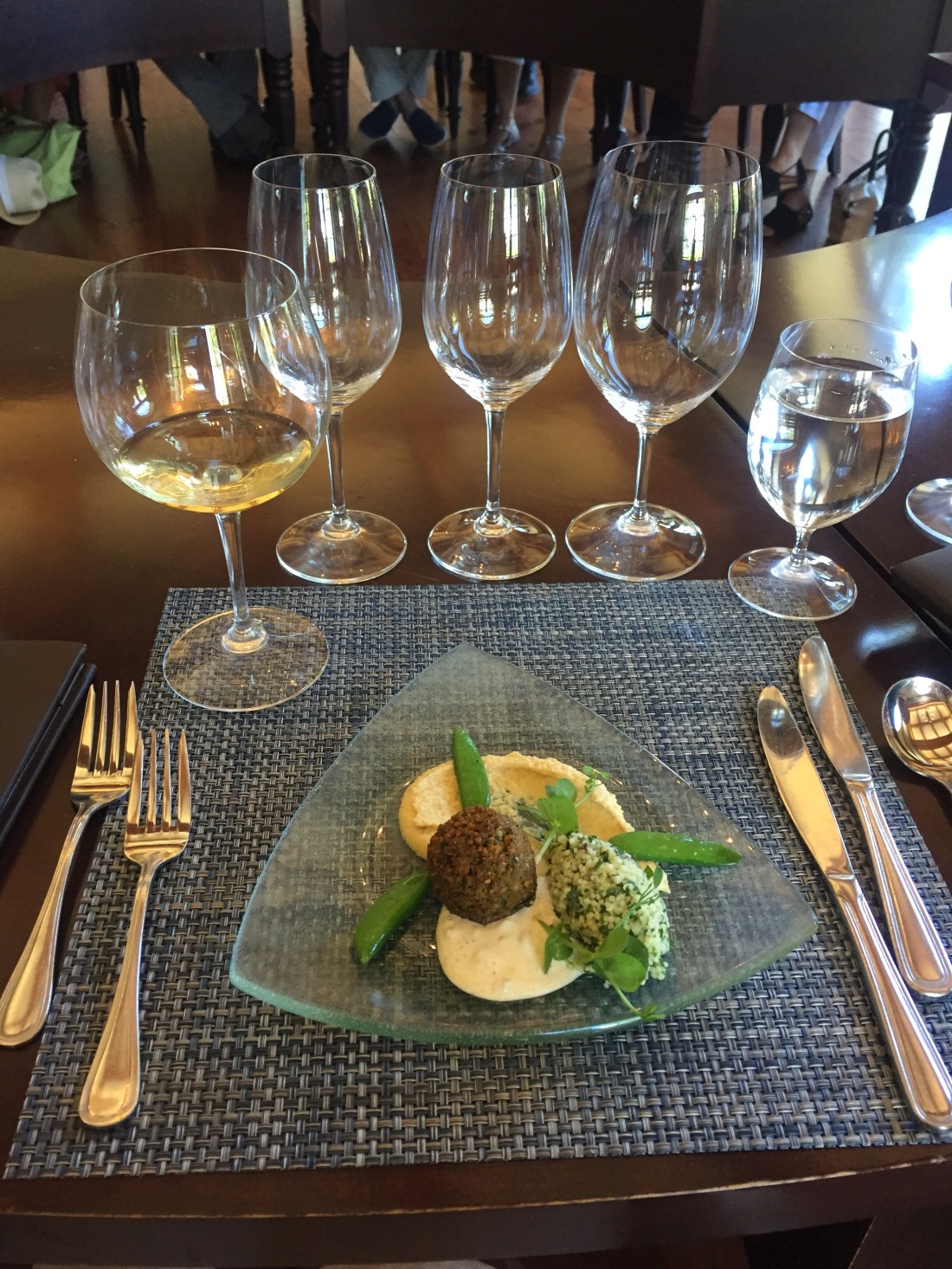
Once it was time for our booking, we were welcomed into the luxurious tasting room.  Our two hosts explained the wine making process, educated us about the grape varietals, and gave tasting notes for each of the 4 wines that went with our dinner courses, and the 5th wine, specially paired with dessert.  In a traditional pairing situation, the food is the star, and the wine is selected to enhance the meal, but at St. Francis, the chef has done the opposite.  He has designed a well thought out menu to showcase the specific taste profiles of each wine, and very successfully so.  He greeted us after the meal to personally answer our questions.

Upon finishing the tasting, my husband and I began to make our selections for purchase.  As participants in the tasting, we were given an additional 15% off of our purchases, which turned out to be a pleasant surprise.  St. Francis has a large selection of varietals and blends to choose from, and they kindly allowed us to taste some additional wines that hadn’t been a part of our lunch pairing.  We found their prices to be reasonable, and left with a full case of some of our favourites, and a special gift for our friends who introduced us to St. Francis in the first place.

Our visit to St. Francis was a highlight of our trip, and I would recommend the investment of time and money there; it doesn’t disappoint!